Can you use isopropyl alcohol on resin miniatures?
Sometimes yes — for a known material, after a hidden-area test, and with short, checked soaks. Isopropyl alcohol (IPA) is the solvent resin-printer maker Formlabs uses to wash uncured photopolymer resin off printed parts. Formlabs pairs that guidance with a condition: wash times are published per resin, not as one universal number (Formlabs).
Stripping dried paint is harder than washing wet resin, so treat it as a controlled test. This is a paint-stripping decision guide, not a mold-line removal method; seams are trimmed and sanded, not dissolved.
"Resin" is three different materials
Solvent compatibility is a property of the material, not the hobby. Work out which one you are holding first.
Material | What it usually is | Why the risk differs | Check first |
|---|---|---|---|
Cast (polyurethane) resin | Poured into silicone molds; common for kits and display pieces | Tolerance depends on the exact formulation, so short checked exposures are the only way to know how yours behaves | The resin maker's guidance and SDS |
UV-printed (photopolymer) resin | Printed on an SLA, DLP or LCD machine, then UV-cured | IPA is the standard wash solvent for the uncured resin, but wash times are set per resin | The printer and resin maker's wash settings |
Polystyrene plastic | Injection-molded kit parts — not a resin at all | Milder than acetone, but "milder" is not "inert"; it can attack paint, decals, putty and some glue joints | The kit or paint maker's guidance |
If a model mixes materials — a resin figure glued to a plastic base — the most sensitive material sets the limit.
Check the maker's guidance before the model goes in the jar
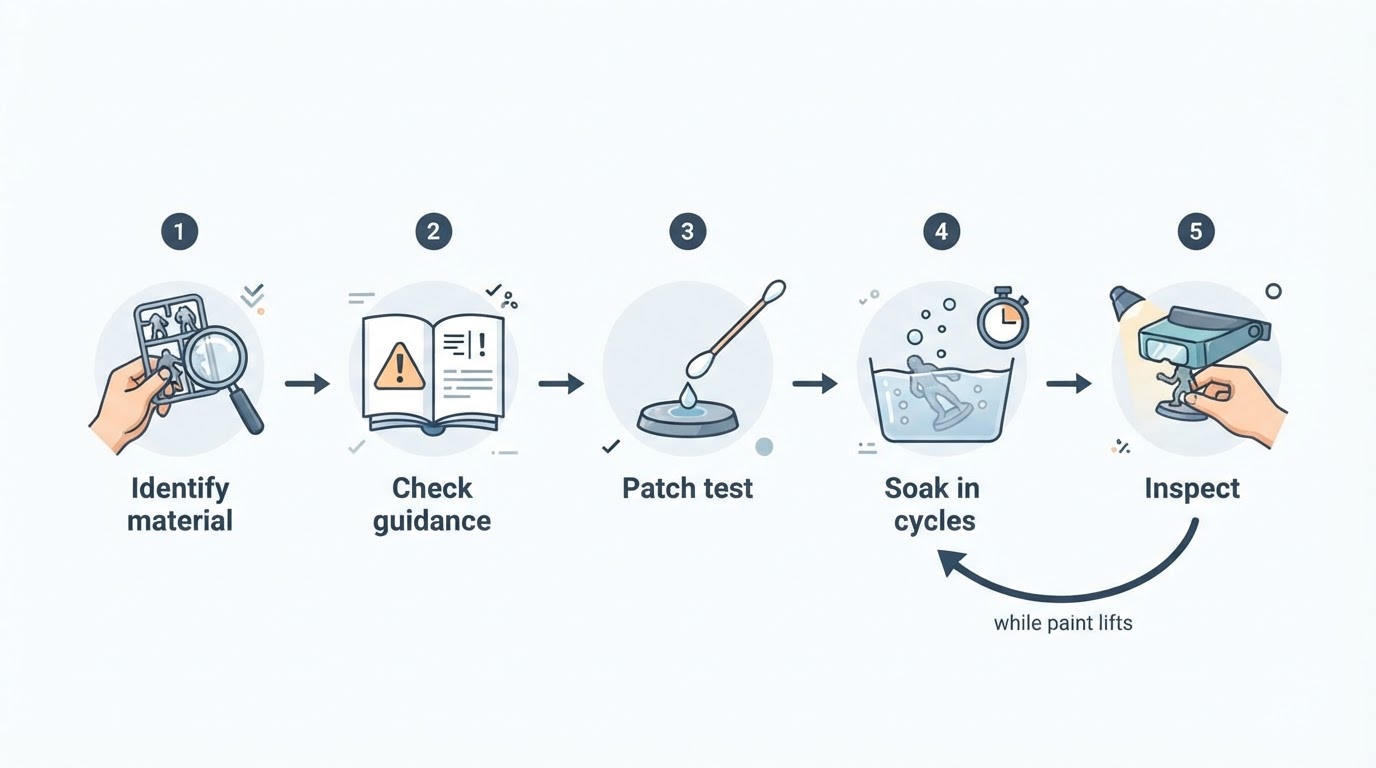
Search the exact resin name with "compatibility" or "SDS" and read the handling section first. Formlabs is explicit that it does not manufacture isopropyl alcohol and that users should consult the chemical supplier for safety information (Formlabs). If a resin has no compatibility guidance or safety data sheet, test on scrap first.
Run a patch test you can actually read
- Pick a hidden area: the underside of a base, an inside socket or a sprue stub.
- Submerge only that area in your IPA, in a covered glass or metal container; a lid slows evaporation.
- Start with brief contact rather than a preset soak. Follow any compatibility time given by the resin maker; otherwise inspect the hidden test area frequently, remove the part at the first change, and let the solvent evaporate in a ventilated area. Formlabs' IPA wash instructions concern its own printed resins, not paint stripping on every miniature (Formlabs).
- Run five checks against dry resin nearby: the patch is hard, not tacky; edges are sharp; no bloom or clouding; thin sections are not warped; the area still flexes without cracking.
- Continue only if every check passes, then strip in short, timed cycles.
There is no universal soak time
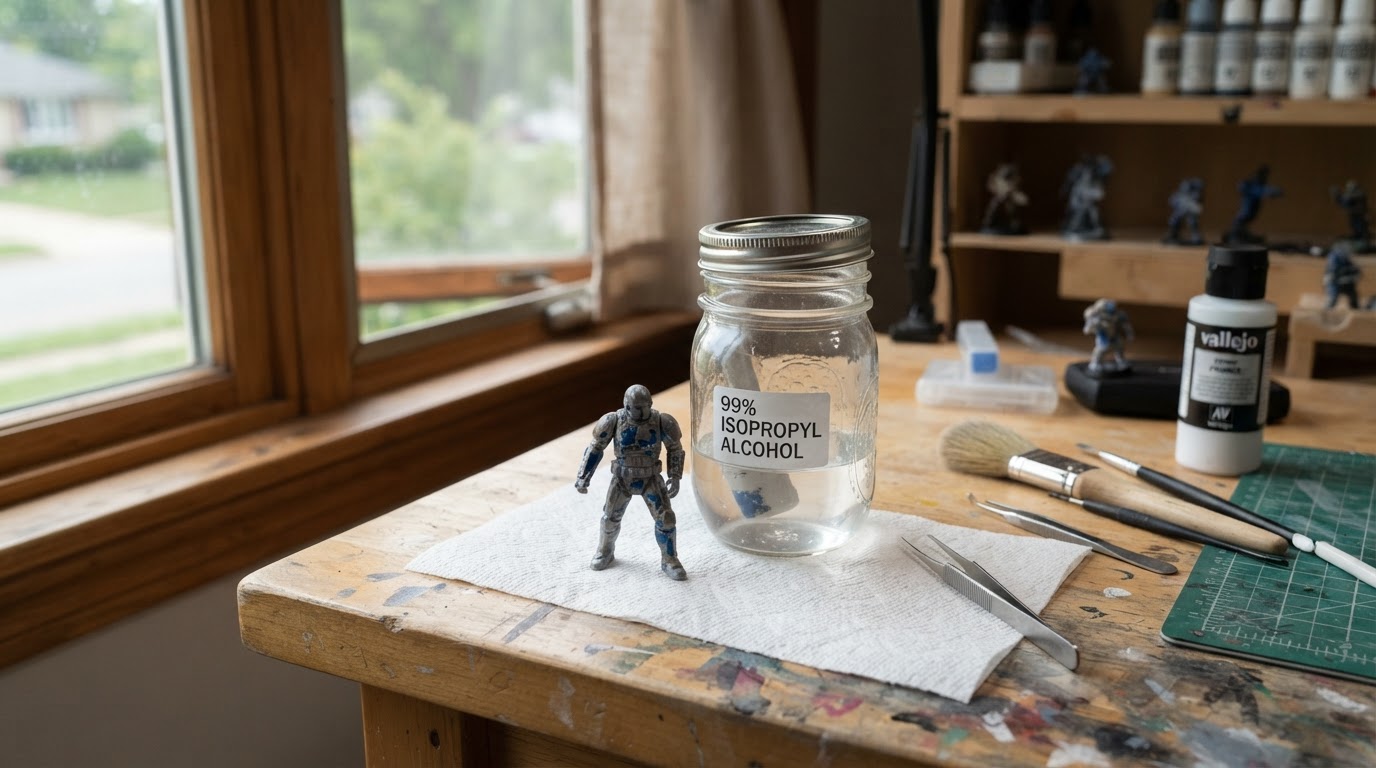
Any single answer for how long to soak miniatures in isopropyl alcohol is a guess: soak time depends on the resin, the part's thickness, the paint and its age, and the alcohol's concentration and temperature. Formlabs publishes per-resin wash settings for removing uncured printing resin; those are not validated paint-stripping times for cast kits or fully cured miniatures (Formlabs).
Run any maker-approved test in short, checked intervals with gentle agitation, and stop if the surface changes. Never park a model in alcohol overnight as a default. If a short test does not lift paint, do not assume that a longer soak is safe; choose a remover approved for the exact material.
70% or 91%: read the label, then test
The label states the real concentration; most of the rest is water. A 91% isopropyl alcohol bottle evaporates faster, while a 70% bottle carries water that slows evaporation and changes how the liquid behaves at the surface. There is no single correct grade for every resin and paint combination: use the grade named in your resin maker's guidance if there is one, otherwise test what you have and change one variable at a time.
Never mix IPA with acetone, lacquer thinner or anything else; mixed solvents are less predictable and much harder to walk back.
Ventilation, fire and skin
OSHA lists IPA's flash point at 53°F and its vapor density at 2.07, so the vapor is heavier than air and can travel along a bench to an ignition source; its exposure limit is 400 ppm as an 8-hour average and its immediately dangerous to life or health value is 2,000 ppm (OSHA). NIOSH guidance is to prevent skin contact, prevent eye contact, and remove clothing that becomes wet because of the flammability hazard; check your glove supplier's breakthrough chart for isopropyl alcohol (NIOSH).
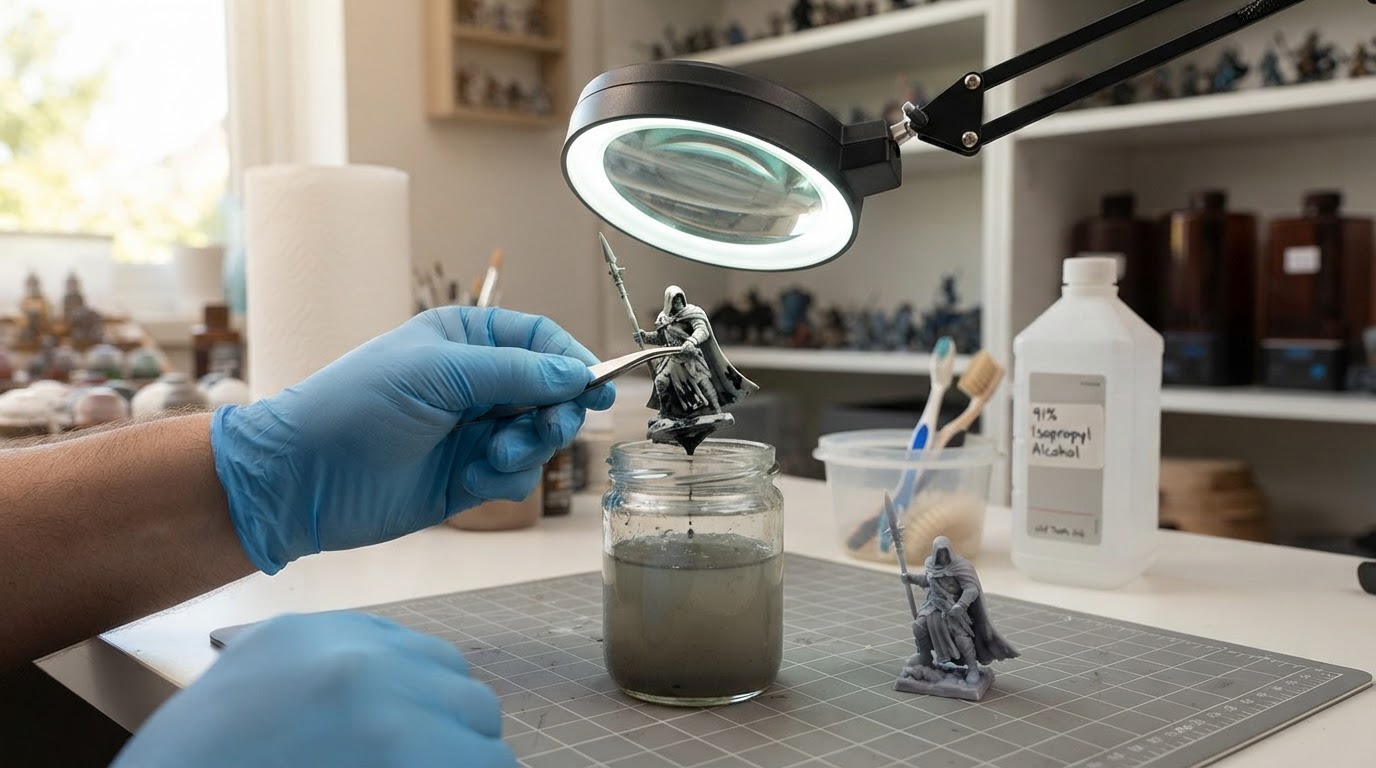
- Work with cross-flow ventilation from a window or fan, and keep containers closed when not in use.
- Keep the jar away from pilot lights, water heaters, sparking tools and open flame.
- Label the jar and keep it away from children and pets.
Stop signs: when IPA is doing damage
Pull the model out, blot away solvent and let it dry safely if you see surface tackiness that does not clear; softening, sagging or warping; rounded edges or lost detail; milky bloom or color change; or loose putty, lifted decals and failing glue joints. Keep contaminated alcohol and any rinse liquid out of household drains.
Some damage can be limited by stopping early, but lost detail cannot be brought back and a tacky surface is not proof the piece will recover. When IPA fails or the material is doubtful, use a hobby paint remover explicitly approved for the exact material; do not escalate to a stronger solvent by guesswork. For a different preparation task, see the site's mold-line removal guide.
FAQs
Does isopropyl alcohol damage resin miniatures?
It can, depending on the resin and the contact time. Cured photopolymer and cast polyurethane resin are different chemistries. The five-check patch test tells you more about your model than any general claim.
Which concentration should I use to strip paint?
Use the grade your resin maker names, if it names one. Otherwise read the label and test the product you own: higher concentrations evaporate faster, while water changes how the liquid works at the surface. Change one variable at a time, and never mix IPA with other solvents.
How long should I soak miniatures in isopropyl alcohol?
There is no universal time. Check the exact material and maker guidance, then make a brief, frequently inspected test on a hidden area. Formlabs' published wash times remove uncured printing resin and should not be reused as paint-stripping times for an unknown miniature (Formlabs). Overnight soaking is not a shortcut.