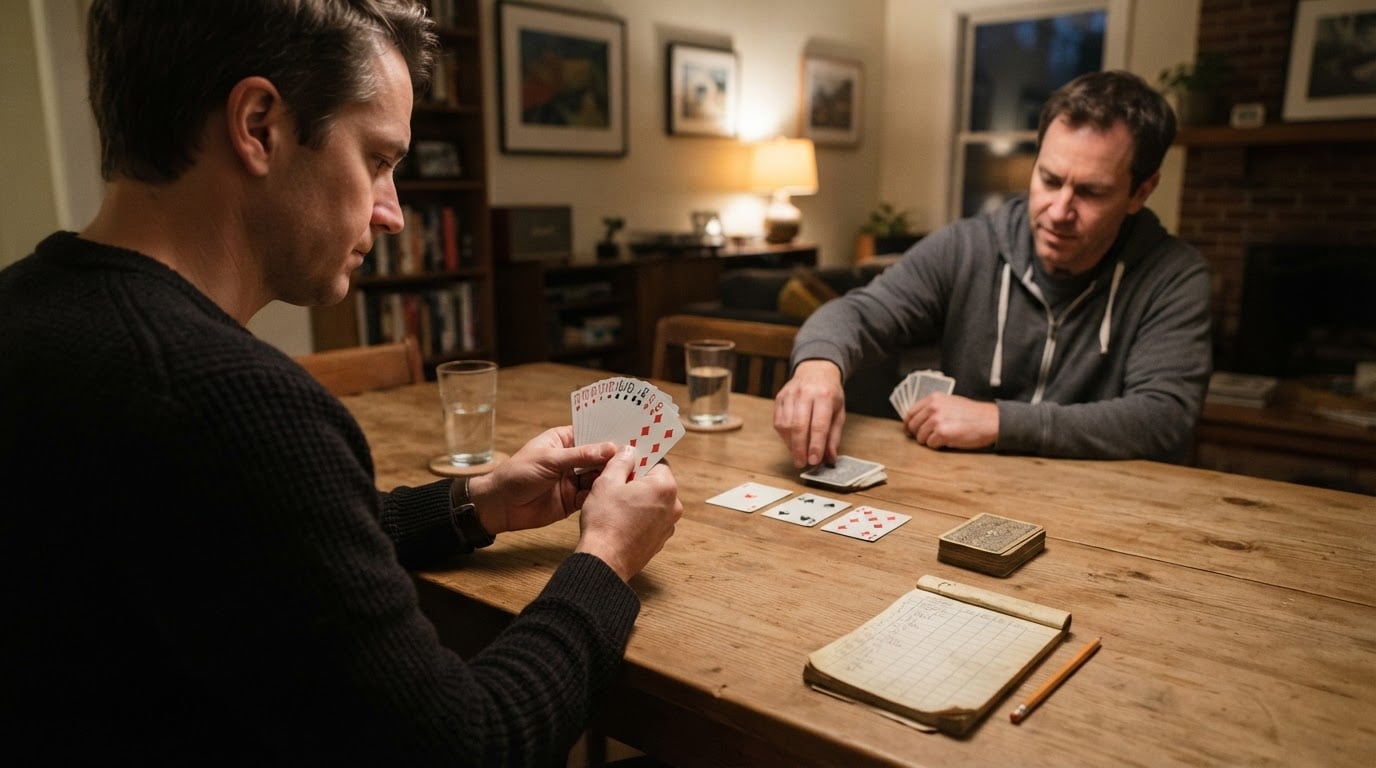
Five checks that decide whether a game works at two
Two-player play is its own design problem. At a full table, downtime is shared and negotiation fills the quiet moments. With two people, every long turn leaves one person watching, every balance wobble shows up immediately, and "it plays fine with two" becomes the most expensive sentence in the hobby.
Before theme, art, or publisher, run a game through these five checks.
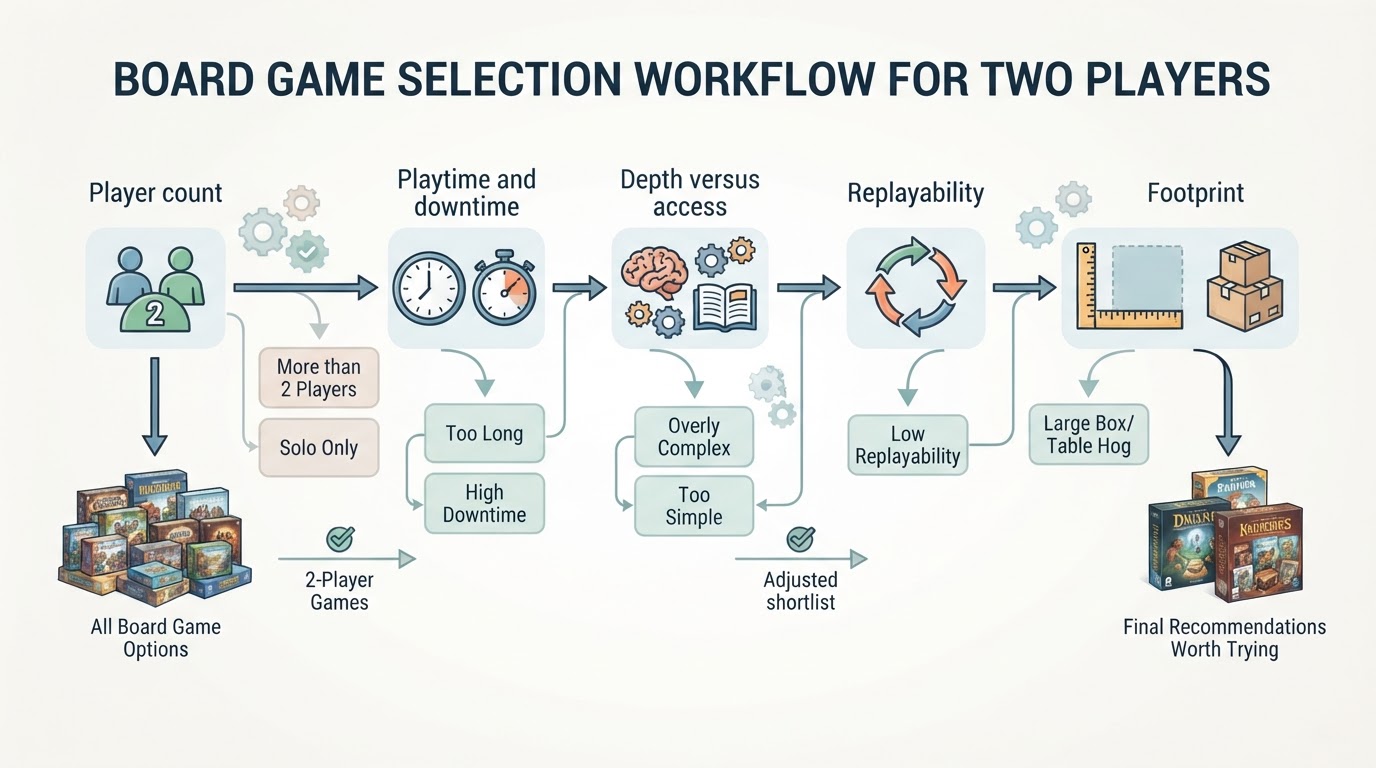
Check | What it means at two players | What to look for |
|---|---|---|
Player count tuning | Whether two is the design's target or an afterthought | A dedicated two-player mode, a two-player board side, or a designer's note |
Playtime and downtime | Total length plus how much of it one player spends waiting | Simultaneous turns or short, interactive turns; a realistic time, not the optimistic box number |
Depth versus accessibility | How much rules overhead stands between you and the first real decision | A short rulebook or learn-to-play guide, plus room to grow |
Replayability | Whether the tenth play still offers a new situation | Variable setup, different factions or boards, or genuinely branching choices |
Footprint | Table space, storage space, and setup space | Board dimensions, component sprawl, and whether it fits your actual table |
Player count tuning: read the box carefully
There are three very different products hiding behind the words "two players."
- Built for two. The design assumes exactly two players, and every mechanism — the market, the scoring, the turn order — was tuned for a single opponent. These are the safest buys when two is your normal number.
- Scaled down to two. A three-to-five player game ships a two-player variant: a dummy player, a closed-off board section, or an adjusted scoring rule. These can work well, but the variant is doing real work. Read it before you buy.
- Technically two. Some multiplayer games list "2" on the box because the rules do not forbid it. In practice the game stalls, one player runs away, or the whole thing turns into a two-hour accounting exercise.
The check is simple: look at the player count, then look for language like "two-player variant" or "two-player rules" in the rulebook. If the two-player mode needs its own page of special rules, that is not automatically bad — it just means you should read that page before you commit.
Playtime and downtime matter more at two
A box that says 45 minutes is describing an average group, not your evening. At two players, a game often runs faster than the box suggests — fewer players means fewer turns, and many modern designs shorten the endgame when the table is small.
The number that actually ruins game nights is downtime: the stretch where your opponent is thinking and you have nothing to do. With four players, a slow turn is a social pause. With two, it is dead air. Games with simultaneous turns, short turns, or constant interaction keep both people in the game; games with long, solitaire-style turns can feel twice as long as their box time.
Before buying, check three things: the printed playtime, whether the game uses simultaneous turns or a shared action phase, and how long setup and teardown take. Storage and sorting time is part of the real cost of a game you play weekly.
Depth versus accessibility: match the game to the pair
"Deep" is not automatically better. The right weight is the one that matches how often you play and who is sitting across from you.
- Light, immediate games teach in minutes and reward instinct. They are ideal for couples, parents, and anyone who wants a game night that does not start with a lecture.
- Medium-weight games reward a few plays without demanding a rulebook reread every session. This is the sweet spot for most pairs who play regularly.
- Heavy games ask for repeated plays and a partner who enjoys the same kind of thinking. They are fantastic with the right person and a shelf ornament with the wrong one.
Read the rulebook's page count, look for a learn-to-play guide, and ask yourself who will be sitting across from you. A game your partner dreads is a game that never hits the table.
Replayability: check what changes between plays
A two-player game lives or dies on its tenth play. If the first game and the tenth game are the same experience, the box is a one-weekend purchase.
Look for variable setup, asymmetric factions, different maps, scenario cards, or multiple paths to victory. Any one of these can keep a small-box game fresh for years. Expansions can add variety later, but they should not be the plan for the base game — if the base game is thin, expansions usually just add more of the same.
Also check for balance notes and any published FAQ or errata. Two-player modes are where balance problems hide, because a single dominant opening is much easier to spot with only two people at the table.
Footprint: the check nobody makes until it is too late
Table space is a real constraint. A grand strategy board with player boards, card rows, and component trays can eat a dining table; a wallet-sized card game fits on an airplane tray. If your game nights happen on a coffee table, a camper table, or a small apartment table, footprint is the first filter, not the last.
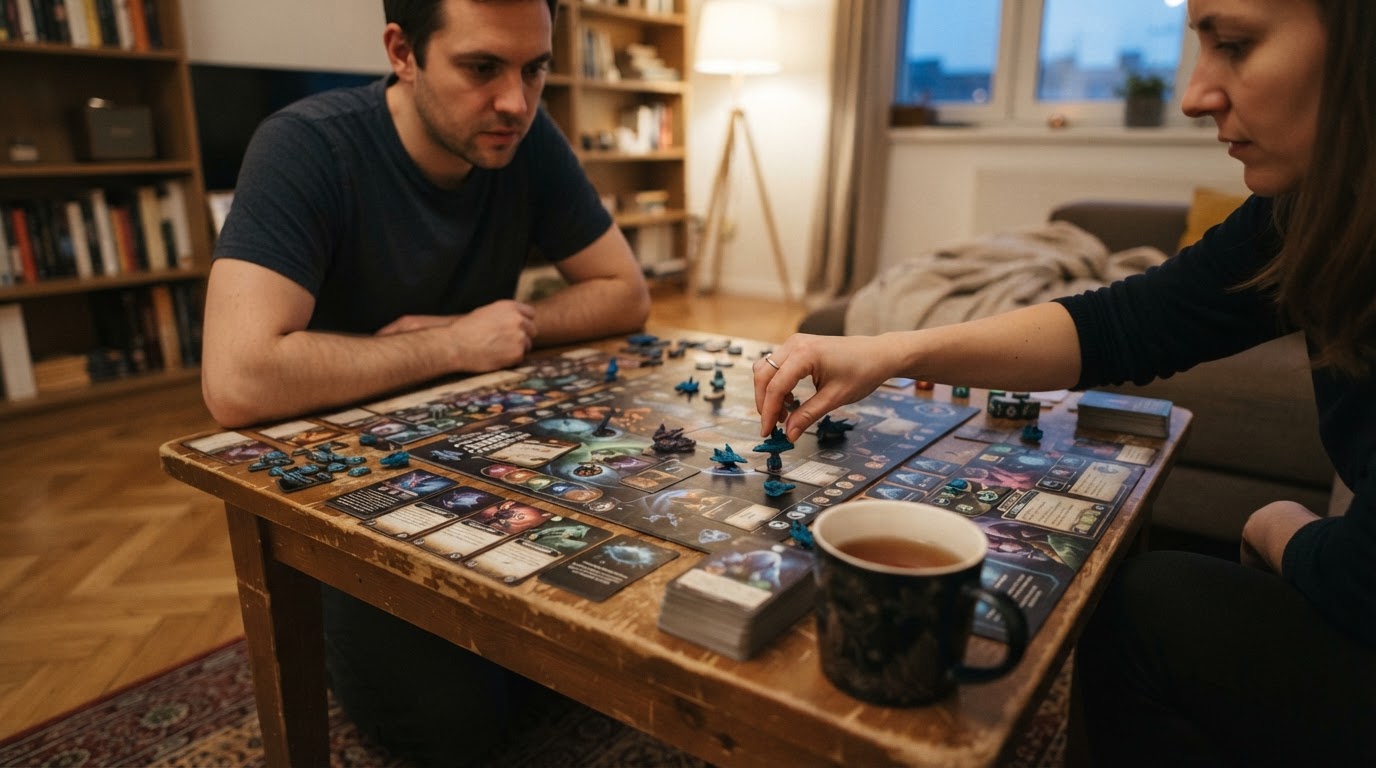
Check the board dimensions and the amount of side space the components need — card rows, personal player areas, and dice trays all want real estate. Then check storage: a game that fits the shelf but not the table is a game that stays on the shelf.
Seven games that fit different kinds of pairs
The picks below are widely available, well-established titles that hold up at two players. Each note gives the kind of pair it suits and the trade-off to accept. Prices, ratings, and stock move constantly, so check a current listing at your preferred retailer instead of trusting any number you read in a guide.
Best for a quiet date-night table
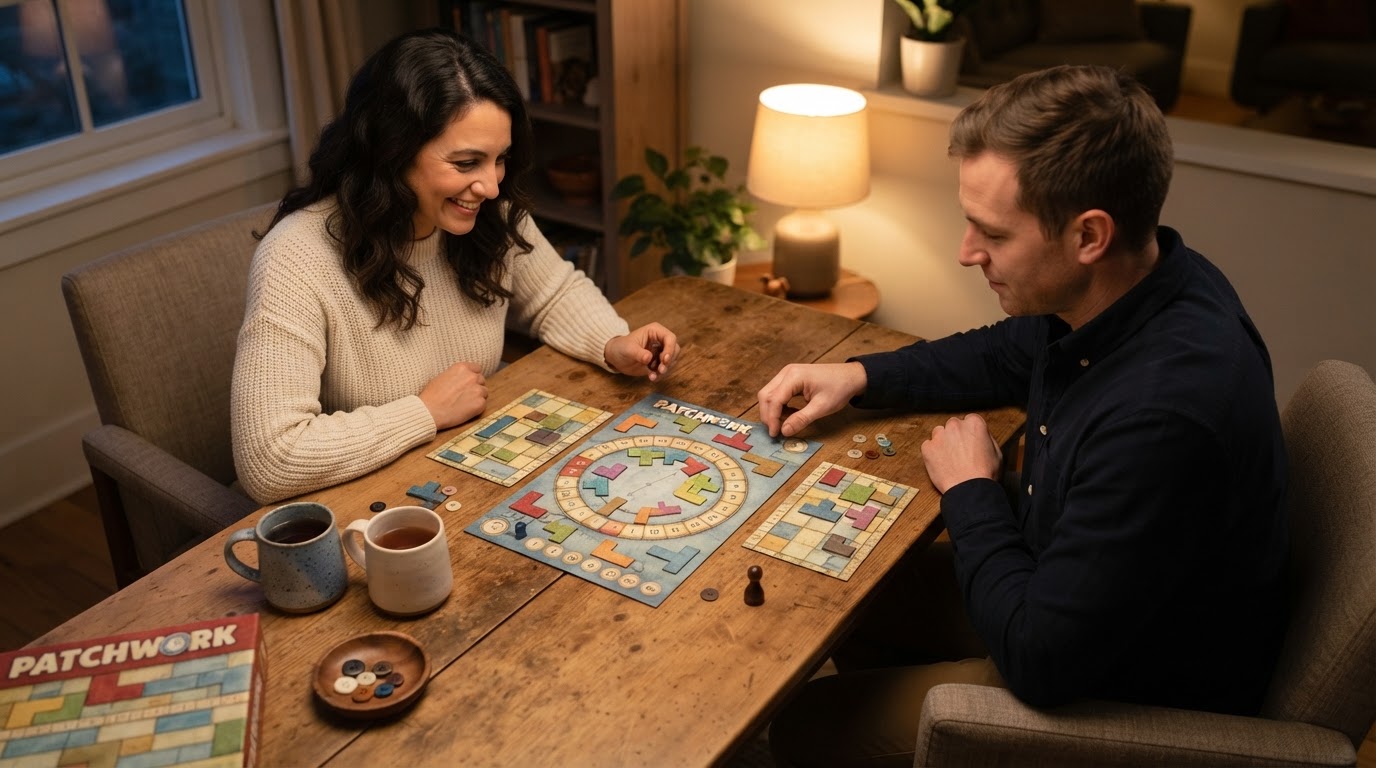
Patchwork — best for calm, low-conflict evenings. Two players build a quilt from polyomino tiles on their own boards, buying pieces from a shared circle and racing a time track. It is easy to teach, has almost no reading, and the interaction is gentle — you mostly compete over the shared tile circle. Caveat: the theme is abstract and there is little direct conflict. If you want table talk, attacks, and bluffing, this is not that game.
Jaipur — best for a fast, chatty round. Two players trade cards at a market, collect camels, and cash in sets of goods for tokens. Rounds are quick, the decisions are constant, and it works as well on a first date as it does on a rainy Sunday. Caveat: the draw can decide a close game, and the same small decisions repeat from round to round. It rewards repeated play, which is either the point or the problem.
Best for a head-to-head strategy duel
Radlands — best for players who want a fight. A two-player card duel where each side defends three camps from a wasteland opponent. Attacks, sabotage, and combos make every turn matter, and the game rewards knowing your deck. Caveat: it is confrontational by design, and the theme and art are not for everyone. If your partner prefers building over attacking, look at the next pick.
Splendor Duel — best for engine builders who still want a race. A two-player-only spin-off of Splendor: collect gems, build a growing engine, and race to points on a shared board where the two players pull against each other. It takes the satisfying escalation of the original and retunes it for two. Caveat: it is more of a puzzle than a conversation, and it does not replace the original's two-to-four-player flexibility.
Best quick filler
Lost Cities — best for a short evening window. A two-player card game about mounting expeditions: play cards in ascending order, decide when to start a suit, and decide when to stop. It fits on a small table, sets up in seconds, and delivers real tension in a short time. Caveat: the scoring is arithmetic-heavy and the draw can swing a hand. It also offers very little direct interaction, so it suits players who enjoy planning more than pestering.
Best for family play
Azul — best for a table that varies between two and four. A tile-drafting game where players take tiles from shared factories and build a wall. It plays cleanly at two and scales up without changing the rules. Caveat: drafting means you can take the tile someone else needed, which can feel mean in a family setting — and at two players, that tension is easier to aim.
Santorini — best for a light abstract that grows with you. Players move and build on a small grid, racing to reach the top level. The base rules take minutes to learn, and the god-power cards add variety once the basics feel solved. Caveat: the base game is simple enough to feel repetitive after a few sessions; the powers are what keep it interesting, so plan to use them.
Classic household games that already play at two
You do not need a new box to have a good two-player night. Several household classics have genuine two-player versions:
- Rummy and gin rummy — a standard deck, a draw-meld-discard loop, and one of the best two-player card games ever printed. Gin rummy is the tighter duel; basic rummy is the flexible family version.
- Cribbage — an old two-player standard for a reason: quick hands, a running score, and a board you can carry anywhere.
- Skip-Bo, Monopoly Deal, and UNO Flip — commercial card games that mostly work at two, with shorter rounds and less downtime than their board-game cousins.
- Farkle — a dice game that becomes a fast back-and-forth at two players.
- Old Maid and Go Fish — simple card games that work with kids and grandparents alike.
The catch with household games is rule drift: every family plays the same game a little differently. House rules are fine as long as both players agree before the first hand. Keep the rulebook with the deck, and settle disputes from the printed rules rather than from memory.
Accessories that genuinely improve two-player nights
Accessories will not fix a game you do not enjoy, but a few inexpensive additions make the games you do enjoy easier to get to the table.
- Playmats define each player's card space, make picking cards up easier, and protect cards on rough tables.
- Dice trays keep rolls on the table instead of under the sofa — especially useful when the table is small.
- Component organizers and sorting trays cut setup and teardown time, which is the difference between a game hitting the table on a weeknight and staying in the box.
- Card sleeves protect the cards you shuffle most. Check the exact card size before buying; sleeves are not universal.
- Card holders help with big hands in rummy-style games and make play comfortable for kids or anyone with limited hand strength.
The rule for accessories: buy them after the game has earned a permanent spot on the shelf. An organizer bought before a game has proved itself is the most expensive purchase in the hobby.
Common mistakes that turn a good game into a shelf ornament
- Buying the theme instead of the player count. The box art tells you what a game looks like, not whether two players get a real game.
- Trusting "2–5 players" as a two-player recommendation. A supported player count is not the same as a tuned one.
- Ignoring downtime. The same 60-minute game feels very different when your opponent's turns are long.
- Starting too heavy. A dense rules teach can end a partner's interest before the first real decision.
- Buying for the table you wish you had. Footprint problems are permanent; a game that needs a bigger table rarely gets one.
- Skipping the two-player variant rules. Many bad two-player experiences are really bad rules reading.
- Accessorizing too early. Organizers, sleeves, and inserts should follow the game, not lead it.
The buyer's checklist
Walk into a store — or open a listing page — with these questions:
- Does the box say "2," and is there a real two-player mode in the rulebook?
- What is the realistic playtime, and how much of it is downtime?
- How long does it take to teach, and who is learning it?
- What changes between the first play and the tenth?
- Does it fit your table, your shelf, and your setup tolerance?
- What does it cost and is it in stock right now? Prices and availability change, so check the current listing rather than any number in a guide.
Answer those six and you will buy fewer games and play more of them. That is the whole point of a two-player shelf: a short list of games that reliably hit the table, instead of a wall of boxes that only looked good in the store.