What fountain pen nib sizes actually measure
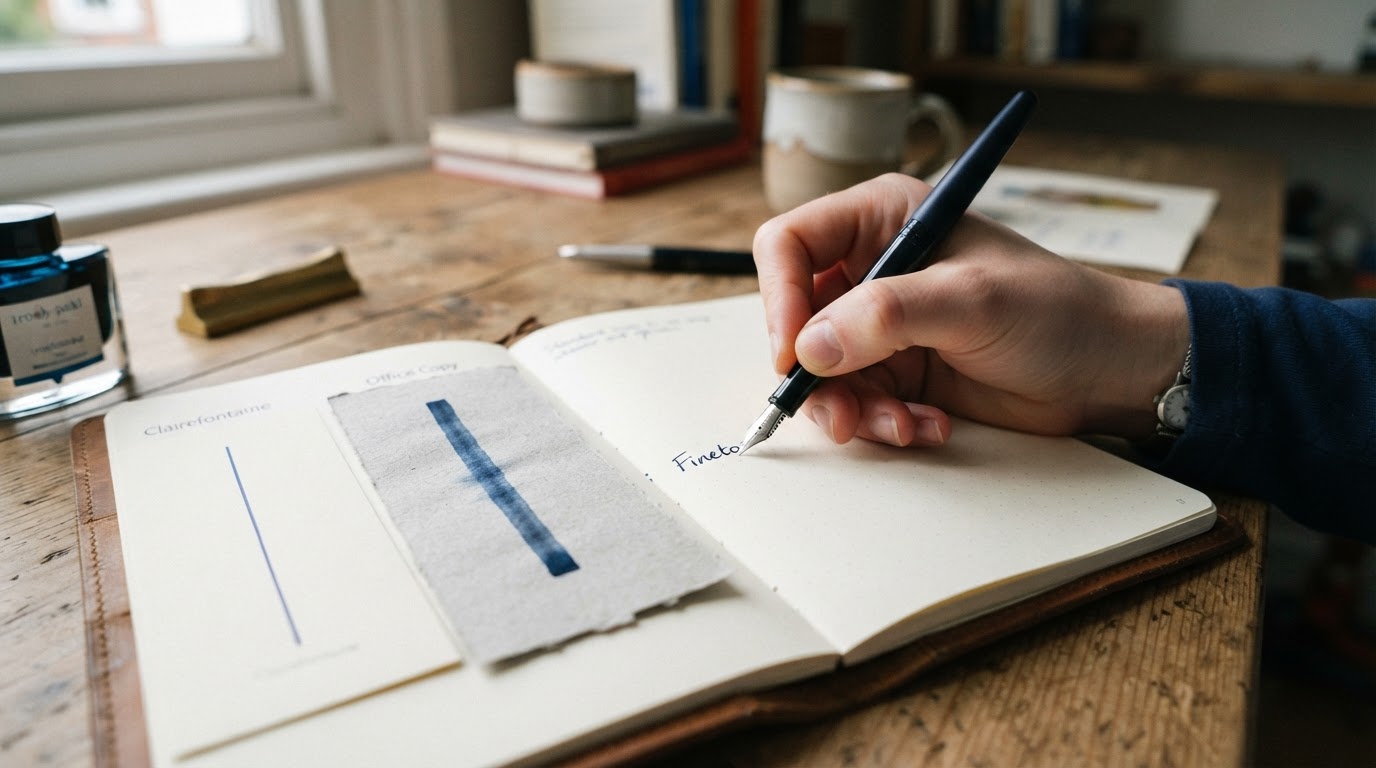
A nib size is the approximate width of the line the nib lays down, not a precise measurement you can carry from one brand to the next. The letter on the nib — EF, F, M, B — describes the shape and size of the tipping, the small, extremely hard pellet welded to the end of the nib and polished into a contact surface. Tipping geometry sets the starting point, but tine spacing, ink flow, feed design, paper absorbency, writing angle, and writing pressure all change the result. That is why a wet fine can look surprisingly close to a dry medium, and why the same nib writes wider on absorbent copy paper than on fountain-pen paper with a hard, smooth finish (Galen Leather).
The grades you will meet most often are extra fine (EF), fine (F), medium (M), broad (B), and double broad (BB). Above and below that range sit ultra extra fine and needlepoint grinds at the thin end, and stub, italic, and flex shapes that change the character of the line rather than simply adding width.
The common nib widths, one by one
Each entry below starts with the short answer, then covers the line width, the writing feel, and the jobs the grade suits — so you can read one and stop.
Extra fine (EF): the precision grade
Short answer: choose extra fine if your handwriting is small or you often write on paper that was never designed for fountain pens.
Western extra fine nibs typically lay down around 0.2–0.4 mm, and Japanese extra fines sit nearer 0.2–0.3 mm (The Pen Archive, ShopToDoGood). The lines are crisp and controlled, which makes EF a natural fit for cramped planners, dense notes, technical work, and fine detail in a sketch. Because it puts down the least ink, it also reduces feathering and bleed-through on absorbent paper. The trade-off is that shading and sheen become harder to see, and the small contact surface transmits more paper texture — an extra fine can be well tuned and still feel every fiber.
Selection advice: treat extra fine as a specialist rather than a default. If you write small but also want a forgiving feel, fine is usually the more comfortable starting point. Pair an extra fine with smooth paper and a well-behaved ink; shimmer particles are more likely to interrupt flow in very fine nibs.
Common questions: Is extra fine always scratchy? No — a properly aligned EF can be very smooth; it simply communicates more feedback. Does a Japanese EF match a Western EF? No; it is usually one full grade finer.
Fine (F): the versatile all-rounder
Short answer: fine is the safest choice when you write an ordinary amount on a mix of papers and want control without an extreme line.
Fine nibs run roughly 0.3–0.5 mm in Western sizing and about 0.3–0.4 mm in Japanese sizing (The Pen Archive). It is the most popular grade worldwide for a reason: enough precision for smaller handwriting, enough flow to feel pleasant, and fast enough drying for quick notes. On office paper it puts down less ink than medium, and on good paper it still shows ink colour clearly, even if shading stays subtler than in a wider nib.
Selection advice: if you cannot test a pen and you write small-to-average, start here. If you already like a Japanese fine, expect a Western fine to feel noticeably broader; switching brands usually means switching a grade.
Common questions: Why does my fine write like a medium? Brand tolerances, a wet ink, wider tine spacing, or absorbent paper can all fatten the line. Is fine good for cheap paper? It lays down less ink, but a very fine tip can catch on loose fibers, so paper quality shows up faster.
Medium (M): the safest default
Short answer: if you know nothing about the writer, medium is the grade to buy.
Medium sits at the centre of the standard range — around 0.4–0.7 mm, with Western mediums closer to 0.55–0.7 mm and Japanese mediums nearer 0.4–0.55 mm (ShopToDoGood). The wider contact surface makes it feel smoother and more forgiving than fine, while the line is still practical for everyday writing. It is also the point where inks begin to show their character: shading becomes visible in medium and wider, and a medium handles shimmer and sheen better than a fine does.
Selection advice: medium is the right default for everyday journaling, correspondence, signatures that should look deliberate without being dramatic, and pens that more than one person uses. If your letters are very small, or you need many words on a page, drop to fine.
Common questions: Do all medium nibs write the same? No — a Japanese medium is closer to a Western fine, and individual makers run fine or broad. Is medium good on cheap paper? Often yes, because the rounder tipping rides over fiber texture more forgivingly than a fine tip; it does put more ink down, so badly bleeding paper can still feather.
Broad (B) and double broad (BB): the ink-forward grades
Short answer: choose broad or double broad when you want the ink to be visible, not when you want to save space.
Broad nibs run about 0.6–0.9 mm in Western sizing, with double broad and stub grinds going wider still. The line is wet, saturated, and smooth, and it makes shading, sheen, and shimmer obvious because so much more ink lands on the page. That same ink volume means faster consumption, longer drying times, and a higher chance of feathering or bleed-through on cheap paper.
Selection advice: broad suits larger handwriting, headings, signatures, and anyone who enjoys ink as much as the pen. If you love ink effects but write small, a stub is usually the better compromise.
Common questions: Is broad too broad for daily writing? Many writers use it daily; handwriting size and paper matter more than the label. Can broad nibs show sheen? Yes — that is their main advantage, provided the paper can hold the ink.
Stub, italic, and flex: width with variation
Short answer: these grinds change the shape of the line, not just its width.
A normal round nib writes roughly the same width in every direction. A stub or italic nib is ground flat, so downstrokes are broad and cross-strokes are thin, which gives everyday handwriting a calligraphic edge without any special technique — a 1.1 mm stub is genuinely usable as a daily writer if your letters are not tiny. A flex nib separates under controlled pressure, moving from an extra fine line to broad or wider; never force an ordinary springy nib to behave like a flex nib (Galen Leather).
Selection advice: start with a stub if you want visible line variation with no technique change; choose flex only if you are willing to learn pressure control.
Japanese vs Western sizes: the one rule worth memorizing
Japanese nibs from Pilot, Sailor, and Platinum run about one full grade finer than Western nibs from LAMY, Pelikan, Montblanc, and most German or French makers. A Japanese fine writes close to a Western extra fine; a Japanese medium close to a Western fine; a Japanese broad close to a Western medium.
Grade | Japanese (approx.) | Western (approx.) |
|---|---|---|
EF | 0.2–0.3 mm | 0.3–0.4 mm |
F | 0.3–0.4 mm | 0.4–0.5 mm |
M | 0.4–0.55 mm | 0.55–0.7 mm |
B | 0.5–0.7 mm | 0.8–1.1 mm |
The gap comes from the writing systems: everyday handwritten kanji needs finer strokes than Latin cursive, so Japanese makers grind thinner for the same letter on the nib (ShopToDoGood). The practical rule is to size up one step when buying Japanese and size down one step when buying Western, then adjust from there. Individual brands still differ: Sailor nibs tend to run fine with pencil-like feedback, Pilot tends to be balanced and consistent, and Pelikan often writes broader than its label suggests.
A nib size number is not a line width
You will also see nibs sold as #5, #6, or #8. Those numbers describe the physical size family of the nib and feed — how large the nib unit is — not how wide it writes. A #6 nib from one maker can be ground to an extra fine or a double broad (Galen Leather). In the same way, a "1.1 mm stub" uses a millimetre figure for writing width while "size 6" uses a number for hardware size. When you shop for a replacement nib, match the size number to your pen and choose the width grade separately.
How to choose a nib size for your hand, paper, and ink
- Handwriting size sets the floor. Small, tight handwriting needs fine or extra fine; average-to-large handwriting is balanced by medium, broad, or double broad. Cramped letters written with a broad nib close up and smear.
- Paper decides how forgiving the nib feels. Absorbent office paper spreads ink outward and fattens every stroke; fountain-pen paper holds a tighter line. On unpredictable paper, finer nibs put down less ink, while medium and broad tipping rides over fiber texture more comfortably. Those two effects pull in opposite directions, which is why a fine that bleeds less can still feel scratchier than a medium.
- Ink is part of the width. A wet, lubricated ink makes any nib write broader and softer; a dry ink tightens the line. Shading appears from medium upward, shimmer works best in broad, double broad, or stub, and both effects are largely wasted in a very fine nib.
- Drying time matters if your hand crosses the line. An extra fine with a fast-drying ink is nearly instant; a broad with a slow ink may still be wet after ten to fifteen seconds. Left-handed writers who drag their hand over fresh writing usually do best starting finer and choosing a quick-drying ink.
- Do not judge by the material. A well-tuned steel nib can feel better than a poorly tuned gold one; tipping geometry, alignment, and flow matter more than the metal (The Pen Archive).
Quick reference
If you… | Start with |
|---|---|
Write very small, or use cramped planners | Japanese fine or Western extra fine |
Write small and want a safe all-rounder | Fine |
Write normally, or want one pen for everything | Medium |
Write large, sign documents, or love ink effects | Broad, double broad, or stub |
Write on cheap, unpredictable paper | Medium for texture; fine or extra fine if the paper bleeds |
Are left-handed and smear easily | Fine or extra fine with a fast-drying ink |
FAQ
Do all fine nibs write the same? No. Nib labels are not universal millimetre standards, and manufacturing tolerances, tine spacing, ink, and paper all shift the line. Two fine nibs from different brands can differ by close to a full grade.
Are extra fine nibs always scratchy? No. They transmit more paper texture, but a properly aligned and polished extra fine can be very smooth. If an extra fine feels harsh, check the alignment, the paper, and the ink before blaming the grade.
What does a #6 nib mean? It is the physical size family of the nib and feed system, not a writing width. A #6 nib can be ground to any width grade; match the number for fit and the letter for line width.
Can I change the nib size after buying? It depends on the pen. Some models accept replacement nib units, while others need a nib meister to reshape the nib. Because grades are not standard between brands, even a direct swap may write differently.
Which nib size is best for cheap paper? If the paper bleeds, go finer to put down less ink. If the paper is rough and catches a fine tip, medium's rounder tipping usually rides over it more comfortably. Test one page before deciding.
There is no single best nib size — only the width that matches your handwriting, your paper, and your ink. Once you know whether your pen uses Japanese or Western sizing, one grade up or down is usually enough to find it.