What the Raphael 8404 is
Short answer: it is a fine-pointed round brush made with Kolinsky sable hair, sold as part of Raphael's Series 8404.
The name tells you two things. Raphael is the brushmaker, and 8404 is the series, which fixes the brush's shape and its size run. A round brush has bristles gathered into a single pointed tip, so it draws thin lines when you work with the tip and lays down a wider stroke when you press the belly onto the surface. Series 8404 is built for controlled work: a fine point, a full belly that holds enough paint for a reasonable stroke, and a seamless metal ferrule joining the bristles to the handle.

Kolinsky sable is natural hair, not a synthetic fibre and not a brand of brush. It is valued for two properties painters notice immediately: it keeps a sharp point through long sessions, and it has a springy snap that lets the bristles return to shape after each stroke. That combination is why the 8404 shows up in watercolour work and in miniature painting, where one brush often has to hold a wash in one moment and paint a highlight the next.
Two boundaries are worth setting before you buy. The series number describes the brush family, not a guarantee about any particular listing, and sellers sometimes use the number loosely, so check that the product you are looking at is the round brush you expect. Natural hair is also a thinner and more seasonal supply than synthetic fibre, so restocks come in cycles. Neither point is a reason to avoid the brush; they are reasons to read the listing carefully.
Quick answers: the Raphael 8404 at a glance
Short answer: the six questions below cover most buying decisions, and each answer stands on its own.
- What is it? A Kolinsky sable round brush in Series 8404, with a fine point and a full belly.
- Is it discontinued? There is no verified public statement that the series has ended. What buyers actually run into is patchy stock, which is a different problem with a different fix.
- Does it come in a set? Sometimes, but a set is not a fixed product. Bundles are assembled by brands or sellers, so the brushes and sizes inside change from listing to listing.
- Which size should you buy? Choose by the stroke you need, not by the number on the handle. Small sizes for detail, larger rounds for washes, and check the seller's size chart because sizing is not identical across makers.
- Where can you buy one? Art-supply retailers and specialist hobby shops stock it when it is available. What matters more than the shop's name is whether the listing shows the actual brush and honours returns.
- What replaces it? Any round with the same three properties: a point that stays sharp, a belly that holds paint, and enough snap to recover its shape.
Is the Raphael 8404 discontinued or just hard to source?
Short answer: hard to source, in cycles. A clean discontinuation is a claim worth verifying rather than assuming, because sellers use the word for two different situations.
The first situation is that the maker has ended the line. The second is that one seller has run out and marked the product as end-of-line in their own system. Those two look identical on a product page and mean very different things for your decision. Distinguishing them takes a few minutes:

- Check whether the manufacturer still lists Series 8404 with a full size run.
- Check more than one seller, including at least one established art-supply dealer.
- Look for a restock date or a notification option. A restock date means the supply chain is still moving; a dead listing usually does not offer one.
Kolinsky hair also sits in a supply chain that is thinner and more seasonal than synthetic fibre, and some sellers have cited paperwork or import requirements as a cause of delay. Treat that as a factor to ask about, not a verdict. If you need a brush this week, the practical answer is to buy the size that is actually in stock and add a second when the restock lands.
Raphael 8404 sizes: how to choose without guessing
Short answer: pick the size by the widest stroke you need to paint cleanly, then size down for detail. The number on the handle is a label, not a measurement.
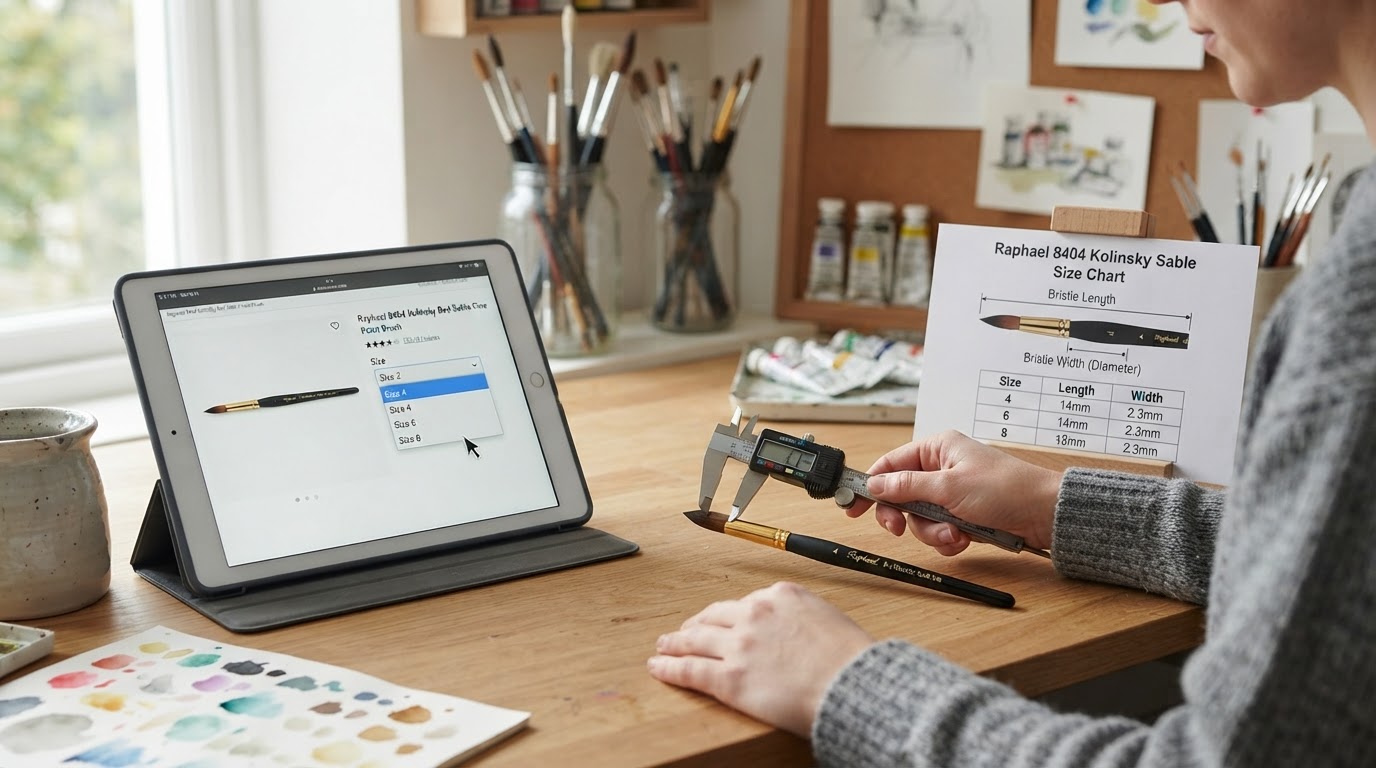
Brush sizing is not standardised between manufacturers, and even within a series the numbering can shift between production runs. A size 1 from one maker can sit closer to a size 2 from another. The useful comparison is therefore not one number against another, but the physical dimensions against what you plan to paint:
- For miniature details such as eyes, edge highlights, and freehand, use the smallest brush that still holds enough paint to finish the stroke without reloading.
- For base coats over a whole model or a large area of watercolour paper, a mid-size round covers ground faster and keeps the paint film even.
- For a two-brush kit, pair one small detail round with one mid-size round. That covers most of what a beginning miniature painter or watercolourist does in a session.
Before ordering, check the seller's size chart for bristle length and width, and look at whether the product photos show the actual brush. A generic photo cannot tell you which size you are buying. If two sizes look close, buy the smaller one for detail work; you can add a larger round later for washes.
What is actually in a Raphael 8404 set?
Short answer: there is no single Raphael 8404 set. Sets are bundles, and bundles vary, so the box matters less than the contents list.
Set listings usually fall into three patterns: a run of the same series in different sizes, a mixed bundle that includes other brush series, and a starter bundle that adds soap, a palette, or a case. Before buying one, check:
- The exact size of every brush in the bundle, not just the number of brushes.
- Whether every brush is Series 8404, or whether the bundle mixes series with different shapes and hair types.
- Whether the price per brush makes sense compared with buying the one or two sizes you actually need.
- Whether the case or accessories are things you will use, or padding that raises the total.
If you are new to natural-hair brushes, a single mid-size round plus one small detail brush is a better starting point than a large set. You will learn how the hair behaves before you commit to a full run.
Where to buy a Raphael 8404, and what to check first
Short answer: buy from a seller who shows the real product and offers a return policy, whether that is an art-supply dealer or a hobby shop.
Availability moves around, so the shop that has your size this month may not have it next month. Rather than memorising store names, use a short checklist:
- Real product photos. You should be able to see the ferrule, the handle, and the bristles.
- A specific size in the listing. Raphael 8404 alone is not enough information; you need the size.
- Clear returns. A natural-hair brush can arrive with a bent point or a loose ferrule, so a return path matters.
- Honest stock status. A backorder with a date is more useful than a vague in-stock message that ships three weeks later.
- Careful shipping. Brushes shipped loose can arrive with the point splayed. A brush that arrives protected is a sign the seller understands what they are shipping.
This guide is part of Tactile Hobby's hobby-gear coverage, and the approach is the same one used here: tell you what to check instead of repeating specs that change between listings.
If you are buying as a gift, add the size and the brush type to the order notes. Natural-hair brushes are personal tools, and the size is the part people care about most.
Replacements: what to look for when the 8404 is not available
Short answer: replace the job, not the model. Match the point, the belly, and the snap, and you will get most of the way there.
There are two broad families to consider. The first is another natural Kolinsky or sable round, which will feel closest to the 8404 in springiness and paint release. The second is a high-quality synthetic round, which trades some of that natural snap for durability and far less sensitivity to rough care.
Whichever family you choose, compare candidates on the same criteria:
Criterion | What to check |
|---|---|
Point | Does the tip form a single sharp point after cleaning, or does it split? |
Belly | Does it hold enough paint for the stroke you need without reloading? |
Snap | Do the bristles return to shape, or stay bent after a stroke? |
Size fit | Does the size match the brush you are replacing, measured rather than numbered? |
Care tolerance | Will it survive your actual cleaning routine? |
Longevity | How many sessions will it last at the care level you will realistically give it? |
Test a single candidate with the paint and thinner you actually use before buying a second one. A brush that behaves well in the shop can behave differently once it is loaded with your paint.
Care that decides whether a sable brush survives
Short answer: a natural-hair brush rewards a two-minute cleaning routine and punishes neglect. That is the real trade-off against synthetics.
The failure mode is almost always the same: paint or water dries inside the ferrule, the bristles splay, and the point never comes back. A workable routine:
- Wipe excess paint from the bristles on a rag, not on the rim of the water pot.
- Rinse in clean water, working the bristles gently against the palm of your hand.
- Work a small amount of brush soap into the hair, then rinse until the water runs clear.
- Reshape the point between your fingers.
- Dry the brush flat or hanging point-down. Never leave it standing upright in water, and never let water sit in the ferrule.
- Store it in a roll or a tube so the point is protected between sessions.
If you know that you paint fast and leave brushes in the water pot, a synthetic round is the more practical choice, and there is no shame in it. The 8404 is the better tool for a painter who will take the extra minute.
FAQ: Raphael 8404 questions
Is the Raphael 8404 good for miniature painting?
Yes, for detail work. It is a fine-pointed round with enough belly for controlled strokes, which is what edge highlights, eyes, and freehand need. For base coats over large areas, pair it with a larger round so the small brush keeps its point longer.
What size Raphael 8404 is best for detail?
Check the maker's size chart and buy the smallest size that holds enough paint for your stroke. Because sizing is not standardised, the number alone will not tell you the bristle dimensions. If you are choosing between two close sizes for detail work, the smaller one is usually the safer pick.
Does the Raphael 8404 work with acrylic paint?
Kolinsky sable is used with acrylics, and the main requirement is prompt cleaning. Acrylic dries fast and hard, so rinse and soap the brush as soon as a session ends, and never let paint dry in the ferrule.
Is the Raphael 8404 worth it?
Judge it by hours of use and care, not by the sticker. A natural-hair brush that holds its point through a long run of sessions can cost less per session than a series of cheap brushes that splay early. If you are unsure, buy one size, use it for a month, and decide from your own results.
Can you use a Raphael 8404 for watercolour?
Yes. The fine point handles detail and the belly carries enough water for washes, which is why the series turns up in both watercolour and miniature-painting kits. Wash it before the paint dries and reshape the point before you put it away.