The short answer: same engine, different finish line
Both games run on one loop: draw a card, shape your hand into sets and runs, discard what you cannot use. From there they part ways on deck size, dealing, knocking, the gin bonus, and scoring.
Rummy is the flexible family version. One deck at a small table or two at a big one, commonly seven cards each, melds played face up during the hand, and a running penalty score that follows you to a target total. Gin rummy is the fixed two-player duel. A single 52-card deck, ten cards each, nothing laid down until someone knocks with ten or fewer deadwood points or goes gin with zero.
If you only need the one-line answer, that is it: same draw-and-meld skeleton, different way to end a hand.
Rummy vs gin rummy at a glance
A table settles a rules question faster than a paragraph. This is the standard version of each game, and house variations are common, so treat your own rulebook as final.
| Rummy (basic family version) | Gin Rummy |
|---|---|---|
Players | 2 to 6, best with three or more | exactly 2 |
Deck | one 52-card deck; often a second deck at a full table, jokers optional | one 52-card deck, no jokers |
Starting hand | commonly 7 cards, and 10 in many two-player versions | 10 cards |
Melding | during your turn, face up on the table | hidden until the hand ends |
How a hand ends | a player melds and discards their last card to go out | a player knocks with 10 or fewer deadwood points, or goes gin with 0 |
Bonuses | none in the basic version | a gin bonus, plus an undercut bonus when the other player finishes lower |
Scoring | leftover cards count against you and the game runs to a target total | the difference in deadwood, with the standard game running to 100 |
Best for | groups, family tables, mixed experience levels | two-player duels and short, sharp hands |
The shared core: draw, meld, discard
Strip the names away and both games run the same three-beat turn: draw one card, improve your hand, discard one card. Your hand is a mix of cards you have organized into melds and cards you are still trying to place. The stock pile feeds the game, the discard pile records what people could not use, and the first player to finish avoids the penalty for everything left in hand.
Two meld shapes do almost all the work:
- Sets, sometimes called books: three or four cards of the same rank, such as three 7s.
- Runs, sometimes called sequences: three or more consecutive cards of the same suit, such as the 5, 6, and 7 of hearts.
That is the whole engine. The differences between the two games are about how long you keep the engine hidden, how many cards you feed it, and what happens when someone finishes first.
Where the rules actually diverge
Deck size and dealing
Rummy is relaxed about equipment. A small game uses one 52-card deck; a full table often adds a second deck, and plenty of versions shuffle in jokers as wild cards. Gin rummy does not adapt. It is a single 52-card deck with no jokers, dealt ten cards to each player, with one card turned up to start the discard pile.
If you remember one equipment difference, remember this: gin rummy is a two-player game with a fixed deck, while rummy stretches to fit the number of people at the table.
Melding during play versus melding at the end
In rummy you can lay melds on the table during your turn. The table becomes a shared workspace, everyone can see what has been played, and some versions even let you add a card to another player's meld. In gin rummy you never lay anything down while the hand is running. Your melds stay in your hand, hidden, until the hand ends.
That single difference is why the two games feel so different. Rummy is open and social; gin rummy is private and tense.
Knocking, gin, and going out
A rummy hand ends when someone melds and discards their last card to go out, or when the stock runs dry and the hand is scored where it stands. Gin rummy replaces going out with knocking.
After drawing, if your unmatched cards total ten points or fewer, you may knock: discard one card face down and reveal your hand. If your unmatched cards total zero, every card is part of a meld, and you went gin instead of knocking. Either way, the hand ends immediately and the other player gets one last look at theirs.
Scoring and the gin bonus
Rummy scoring is a running penalty. When the hand ends, every player counts the cards still in hand. Face cards are usually worth 10, number cards are face value, and aces are worth 1 or 11 depending on what your table agreed. Those points go against the player holding them, and the game runs to a target total such as 100 or 500.
Gin rummy scores the hand, not the whole game state. The knocker compares their deadwood total with the other player's. The lower total wins the difference. Going gin adds a bonus on top, commonly 25 points, and an undercut adds a bonus when the other player finishes lower. The standard game runs to 100 points, and those numbers move around in house rules, which is exactly why the rulebook wins every argument.
Two-player play changes both games
When you sit down with just one other player, the pace and the math both shift.
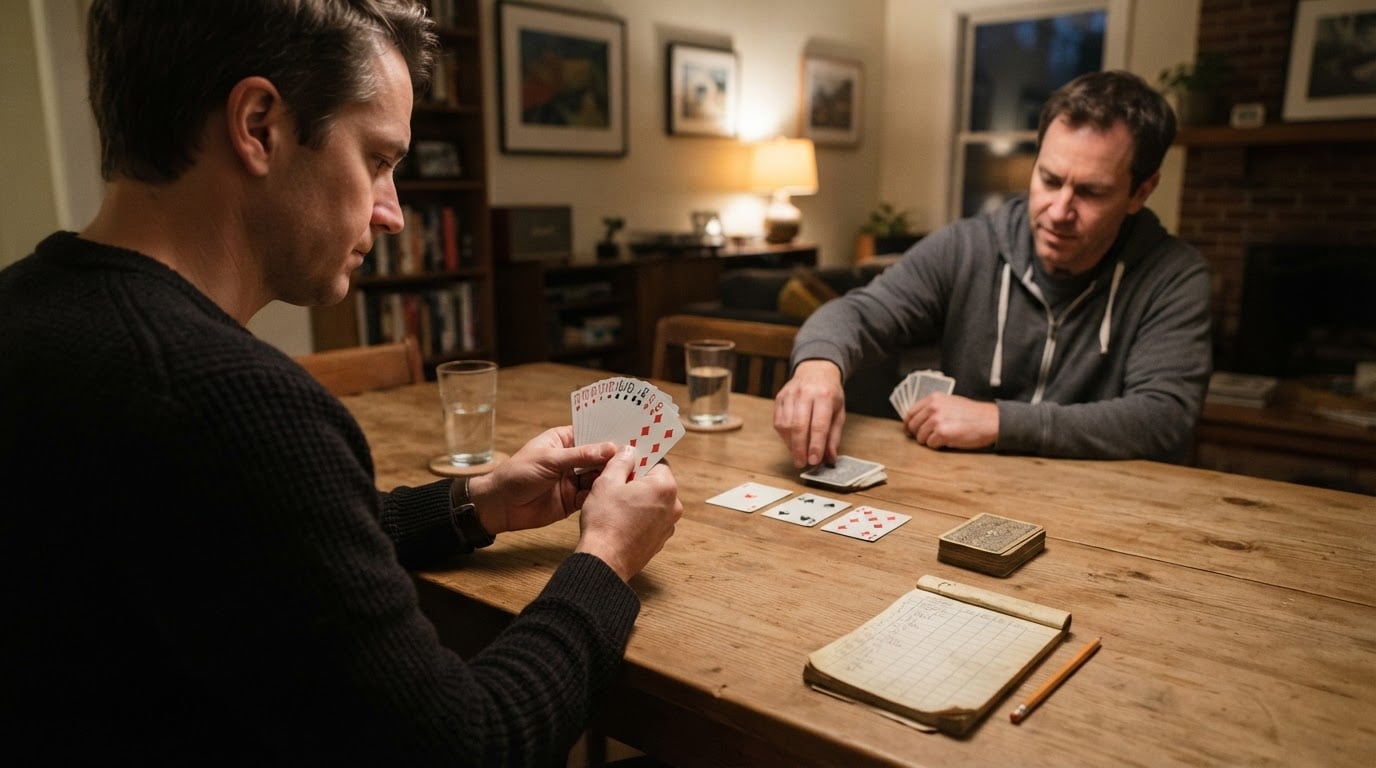
Gin rummy was designed for two, so it needs no adjustment. Rummy with two players is a different animal from a five-player table: the stock drains faster, the discard pile becomes the main source of useful cards, and you have to read what your opponent is collecting from the cards they throw away. Many two-player rummy versions deal ten cards instead of seven to give each hand more shape.
If you are choosing between the two for a two-player game night, pick based on what you want from the evening. Gin rummy rewards tight discarding, because every card you throw away is a clue and a gift. Rummy rewards patience and flexibility, and it forgives a rough opening hand more easily.
Common rule confusions, and how to settle them
Most arguments at the table come from carrying a rule across from the other game. Here are the ones that come up again and again.
- "Can I meld now?" In rummy, yes, during your turn. In gin rummy, no, not until the hand ends. Players who learned one game first trip on this constantly.
- Are jokers wild? In many rummy versions, yes. Standard gin rummy uses no jokers at all.
- How much is an ace worth? In gin rummy the ace counts as 1 and is only low, so A-2-3 works but Q-K-A does not. In many rummy versions, the table agrees whether aces are high, low, or both, and that decision changes which runs are legal.
- Can I take the whole discard pile? Some rummy versions let you buy the pile; gin rummy limits you to the top card.
- Can I lay off cards after a knock? In standard gin rummy the other player may lay off deadwood onto your melds before counting. Plenty of house rules forbid it, so say the rule out loud before the first hand.
- Is it ten or zero? The knock threshold is ten deadwood points in standard gin. Zero deadwood is gin, not a knock, and the bonus is different.
- Who can take the first discard? In standard gin rummy the first player may not take the opening upcard. Rummy versions that allow picking up the discard often have no such restriction.
When a detail is not covered by the version in front of you, the game's own rulebook is the final word. Printed rules, deck inserts, and family house rules disagree on exactly these points, so decide before you deal rather than mid-hand.
Which game should you try first?
Use the player count first, then the mood of the table.
Try rummy first if you have three or more players, mixed experience levels, or a group that wants to talk while it plays. Rummy is forgiving, melds build in public where beginners can study them, and a slow table does not ruin the game.
Try gin rummy first if you have exactly two players and want short, self-contained hands. Gin rewards counting, second-guessing every discard, and reading one opponent closely. A single decision, knock or keep playing, can flip an entire hand.
The trade-off is openness against tension. Rummy is a social game that happens to use cards. Gin rummy is a quiet duel that happens to be played at a table. Neither is harder to learn than the other; they just ask for different kinds of attention.
One-minute rules check before you deal
If you remember nothing else, remember the finish line. Rummy, basic version: seven cards, melds face up, the hand ends when someone goes out, leftover cards count as penalties, and the game runs to a target total. Gin rummy: ten cards, melds hidden, the hand ends when someone knocks at ten deadwood points or fewer, or goes gin at zero, and the score is the deadwood difference plus any bonus.
Both games are easier to teach with a real deck in hand than in a paragraph. Deal a practice hand, keep the rulebook within reach for the first game or two, and settle the house rules before the first knock.