What Skip-Bo Is, and What People Mean by "Skip-Bo Online"
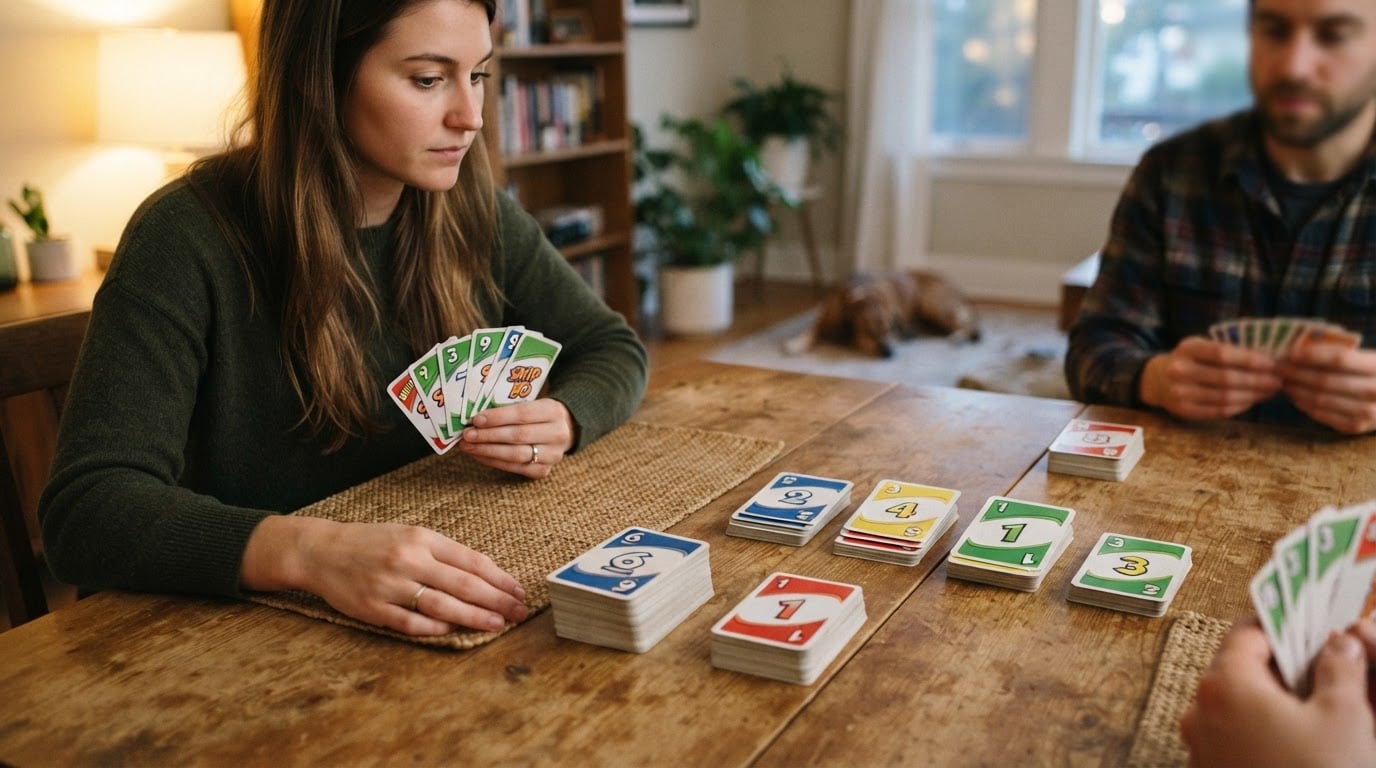
Skip-Bo is a Mattel card game that plays like a shared game of solitaire. Each player gets a personal pile of cards to clear, and everyone builds the same center piles together in numerical order, 1 through 12. There is no bidding, no trick-taking, and almost no hidden information — only the top card of each player's own pile is face up, and everyone can see it. That is why it works at a mixed table: a 7-year-old and a grandparent can play the same hand and both have a real chance.
A search for "skip-bo online" usually means one of two things. Either the box and the rule sheet are long gone and you want the rules in plain language, or you want to play on a screen and don't know which version is the real thing. The rules and setup come first below; the last three sections cover how to vet a digital version, including what to do when a link stops working.
One honest note before the rules: Skip-Bo rule sheets have been reprinted for decades, and small details vary by edition. Where this guide and the sheet in your box disagree, the sheet in your box wins.
Skip-Bo Setup: What Goes on the Table
Everything comes out of one 162-card deck, and it breaks down like this:
- Number cards: twelve copies of each number from 1 to 12, for 144 cards.
- Wild cards: 18 Skip-Bo cards that can stand in for any number.
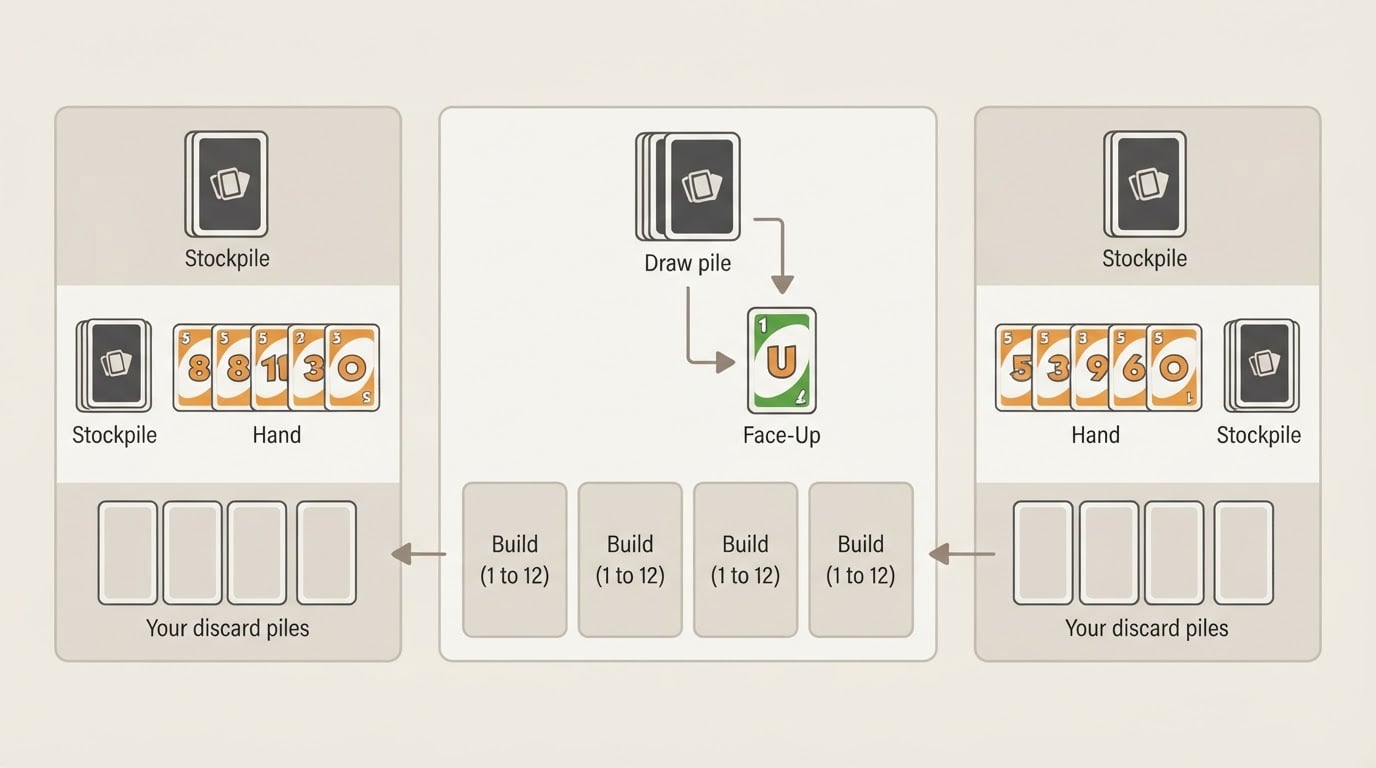
- Each player's stockpile: 30 cards dealt face down, with the top card turned face up. Clearing this pile is the entire win condition.
- Each player's hand: five cards to start.
- The draw pile: the rest of the deck, face down in the middle, with one card turned face up beside it to start the first discard pile.
Two things about the layout are worth saying out loud. First, the stockpile belongs to one player; nobody else plays on it, and only its top card is visible. Second, the stockpile is the clock. Every card you play out of it is one card closer to done, but the cards underneath can only be reached in order, so the game is as much about digging as it is about dealing.
This is also the point where the table size matters. Each player needs a full 30-card stockpile plus a five-card hand, so a single 162-card deck comfortably seats a small table; if your box lists a bigger player count, it is using a variant setup, and the box or rule sheet is the one to follow.
How a Turn Works: Draw, Play, Discard
A turn has three beats, and the order matters.
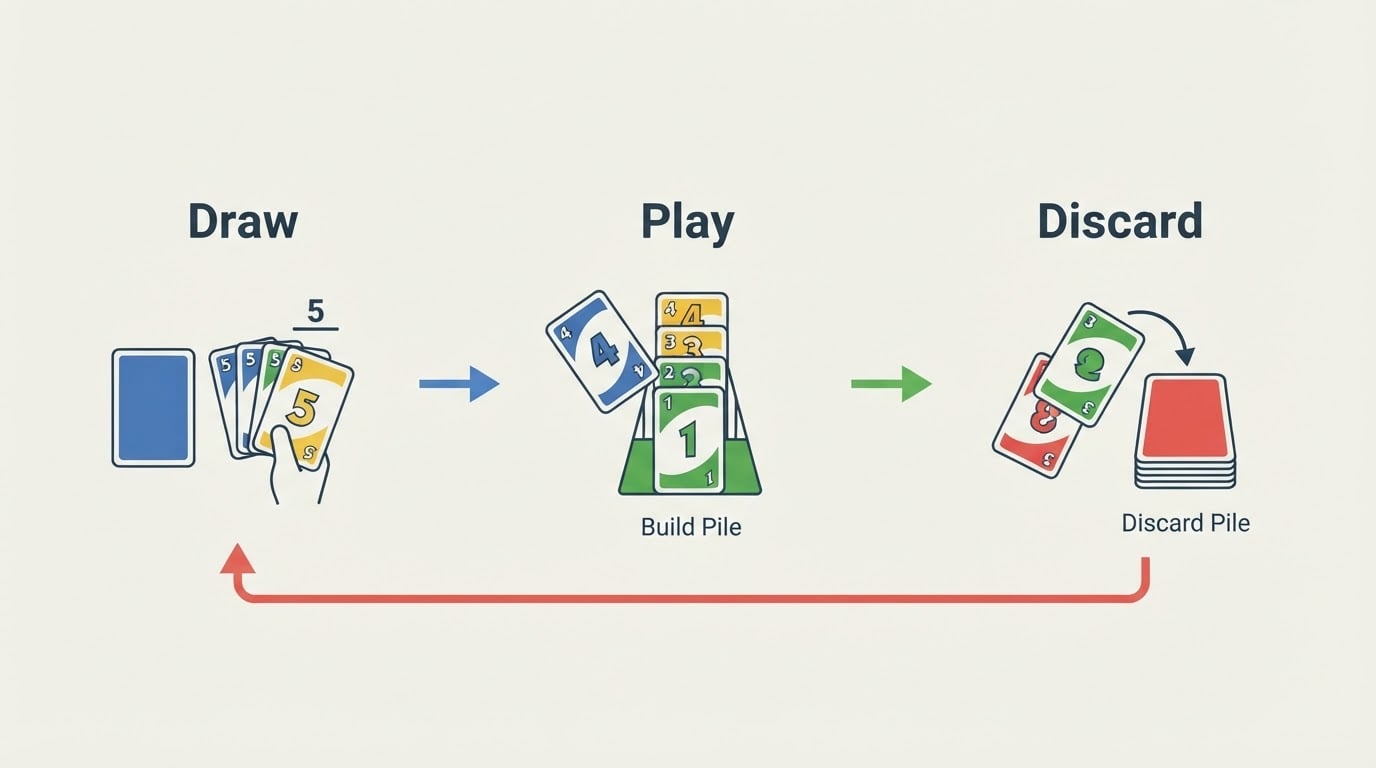
- Draw back up to a full hand. At the start of your turn, take cards from the draw pile until your hand is back to five. If your hand runs empty mid-turn, refill it to five and keep going.
- Play whatever fits. You can play cards from your hand and the top card of your stockpile. Cards go onto the center build piles, which always count up: a 1 starts a pile, then 2, 3, 4, and so on to 12. A wild card can take any value you need. You keep playing as long as something fits — there is no limit on how many cards you play in a turn.
- End with a discard. When nothing else can be played, move one card from your hand onto one of your own discard piles. That closes your turn, and the next player goes.
Two build-pile details trip people up. When a pile reaches 12, it is complete: set it aside and use that same spot to start a new pile at 1. And the middle holds up to four build piles at once, so watch all of them, not just the one you started.
The Rules Questions That Come Up in Real Games
How much is a wild card worth? Whatever the pile needs at that moment. You decide when you play it, and it counts as that number for good.
Can I look through my stockpile? No — the top card is the only one anyone sees, including you. Everything else stays face down until you uncover it.
How many discard piles do I get? Up to four, and only you may play on them. A discard pile builds in sequence, one number higher or lower than the card on top, so a pile can run up or down. You may start a new discard pile with any card as long as you have fewer than four going.
Can I play on someone else's discard pile? No. Discard piles are personal storage, which is exactly why they matter: they are where you park cards you will need later.
What if the draw pile runs out? Gather the discard piles, leave the top card of each in place, shuffle the rest, and use them as a fresh draw pile. The game continues.
What happens to completed piles? They are set aside and stay out of play. If your table wants to return them to the draw pile, that is a house rule worth agreeing on first.
Can I end my turn early? The turn always closes with a discard, so you are never stuck holding a turn open. Whether you have played one card or twenty, the discard is your off-ramp.
How You Win, and Where Scoring Comes In
The standard finish is a single event, not a tally: the first player to play every card out of their 30-card stockpile wins. The moment that happens, the round is over.
Scoring is where editions and family traditions diverge, so this is the part to settle before you deal. The classic rules are a race rather than a points game, which means a running score is a house convention. Three ways to keep a series fair:
- Play a fixed number of rounds and count round wins, with the dealer rotating each round.
- Score each round by the cards left in every stockpile when the winner finishes, then add those up.
- Play to a fixed time and see who clears their stockpile first within it, then reset.
Whichever you choose, say it out loud before the first deal. Most Skip-Bo arguments are not about the rules on the sheet — they are about a scoring method nobody agreed to.
Skip-Bo Online: How to Vet a Version Before You Trust It
This is the part the search term is really about, and it is the part with the least reliable information on the open web. Plenty of pages offer an official-sounding Skip-Bo that is not one. Skip-Bo is a Mattel title, so a sanctioned digital edition should trace back to Mattel's own publishing footprint. Run this check in order:
- Start at the publisher, not at a search result. Find the game's official home first, then follow its links out to whatever it officially offers on the platforms you use.
- Read the developer field on any listing, not the title. Store listings name the developer or publisher. A listing called "Skip-Bo Online Free" whose developer field is an unfamiliar studio is a signal to slow down and compare.
- Watch what it asks of you before a single card is dealt. A page that wants an account, a card, or a "verification" step before it shows you a game is not the one you came for.
- Compare the rules it teaches with the rules above. If it changes the 1-to-12 build order, the stockpile win condition, or the wild-card behavior, it is a variant — fine if it says so, a problem if it does not.
- Treat "free" as a question, not a price. Free versions fund themselves somehow. What matters is whether the listing says how, so you can decide before you are three turns in.
When a Skip-Bo Link Doesn't Work
Dead links are normal for digital card games. Titles get retired, renamed, re-listed for new devices, or restricted by region. Instead of trusting the next link that shows up, work outward from the source:
- Go back to the game's official page and look for its current games or apps directory.
- In the app store, go to the publisher's developer page directly and see what it lists today, rather than searching the game name.
- Check whether the title was renamed. A retired name is often replaced by a successor.
- Check your region. A listing that works for one country may not be offered in yours, and that is a distribution decision, not a broken link.
- If you land on a mirror, aggregator, or reposted download, treat it as unofficial unless the publisher's own page names it.
None of this is a reason to skip the game. It just means the safe path is publisher first, platform second, and search results last.
Free or Paid: The Questions That Actually Decide It
There is no universally right answer here, because the two models buy different things. A paid version is usually buying a clearer deal and fewer interruptions; a free version is buying a lower entry price and accepting that it is funded another way. Rather than pick a side, run both options through the same short list:
- Does the listing name its publisher or developer, and does that name match the game's owner?
- Is the price clear before you install or sign up — and if it is free, is the funding model stated plainly?
- Does it require an account, and what does it ask for?
- Can you play offline, and does it support the number of players your household actually has?
- Does it teach the classic rules, and can you tell whether rule changes are optional variants?
- How does multiplayer work — same device, same room, or over the network?
If you cannot answer the first question, the rest do not matter. If you can, the choice is usually a preference about ads versus upfront cost, and either is defensible.
If You Just Want the Rules in Plain Language
Sometimes the search is not about a screen at all — it is about wanting a rules refresher you can read in a few minutes without hunting down a box in the attic. That is the gap Tactile Hobby's rules explainers aim at: plain-language walkthroughs for household card and board games, with Skip-Bo sitting alongside titles like Farkle, Monopoly Deal, UNO Flip, Old Maid, and Go Fish, plus advice on player counts and games that work for a group. It is a reasonable pre-game double-check, especially for the small variants every family plays slightly differently. For your edition's fine print, the sheet in the box is still the tiebreaker.