The short answer: usually yes for water-based hobby acrylics
Most people asking this are holding two water-based hobby acrylics, and in that common case the paints can normally be used on the same model and can be blended on a palette. The answer stays conditional because "acrylic" describes a binder family, not one formula. Pigment load, binder ratio, finish, and additives vary by manufacturer and by product line, so two bottles that share a category name can still behave differently.
Liquitex, which makes acrylic art materials, says in its own FAQ that its acrylic paint "is generally compatible with other acrylic products," while warning that lightfastness, flexibility, yellowing, and UV protection may vary between brands. The same answer recommends an adhesion test. That is manufacturer guidance for its own products, and it still ends with a test; it is not a guarantee that any two miniature paints will behave identically.
Before you mix anything, separate three situations that get blurred together:
- using two brands in separate, dried layers on the same model;
- blending two wet paints on a palette;
- combining different paint chemistries.
Those are different jobs. A good result in one does not prove anything about the other two.
How to identify the paint family before you open a bottle
Read the thinning and cleanup instructions first
The most useful label clue is not the word "acrylic" but what the maker says about thinning and cleaning up. Water-based hobby acrylics are typically thinned with water or with a matching acrylic medium or flow improver, and brushes clean up in water before the paint dries. If you are new to that routine, our guide to painting miniatures with acrylic covers the thinning and cleanup basics. Enamels, lacquers, and solvent- or alcohol-based acrylics are formulated for a specified solvent thinner, and their cleanup follows the same chemistry. If the instructions call for white spirit, lacquer thinner, or a branded solvent, treat that product as a different paint family and keep it out of a water-based mix.
Do not treat "acrylic" as a compatibility badge
Acrylic paint for miniatures covers a wide spread of products: standard brush colors, pre-thinned airbrush colors, washes, contrast-style paints, metallics, and mediums. Even inside one brand, those sub-types can differ in pigment load, binder ratio, finish, and drying behavior. When you combine two of them, you are not just combining colors; you are combining two formulations. The result does not simply average out. Sheen, coverage, opacity, and handling can change in ways neither bottle predicts, and the same pair can behave differently at a different mix ratio.
Pigment that settles or separates in the bottle is a different question from a mix that misbehaves on the palette. Bottle separation is usually about storage, pigment density, and shaking, and it says nothing about whether two brands will combine; our note on miniature paint separating in bottle covers what that looks like and how to bring the paint back into suspension. A blend that separates after mixing is not the same signal, and neither observation alone proves a chemistry problem.
That unpredictability is also why finish matters. A matte acrylic mixed with a satin acrylic will not necessarily land between the two finishes: the blend can dry glossier or flatter than expected, or dry unevenly across a large smooth armor plate. If the final sheen has to match, test the pair together and compare the dried result with swatches of each original rather than assuming the mix will inherit the finish you wanted.
Layering two brands is not the same test as mixing them wet
Using brand A for a basecoat and brand B for a highlight is only a reasonable plan when the first layer is ready for the next product according to its own instructions. That often means dry and handleable rather than fully cured, but the label sets the condition, and some products ask for longer. Wet mixing is a different situation: the pigments and binders are combined while both paints are still fluid, so they form one new film. A wet blend can look smooth on the palette and still dry unevenly, and some blends can soften or lift a layer underneath, although that is not guaranteed for every pair. Separate dried layers avoid the wet-blend question, but they introduce their own: whether the second product adheres to the first.
Liquitex makes this distinction in its intermixability article. It guarantees 100% compatibility across its own ranges because those products share compatible binder systems, and it says that guarantee depends on its own formulation work. The same article warns that acrylic paints from different sources can produce unpredictable results, including incompatibility of the acrylic emulsion or flocculation of the pigments. In plain terms: the paint may stay tacky when dry, may not adhere properly, may flake or peel over time, and may have unpredictable lightfastness. Those warnings are about mixing products from different sources, so do not read the company's own-range guarantee as a statement about every hobby brand on the shelf.
Practical consequence: if your plan is two separate layers, test that layering order on a scrap piece and follow each label's recoating conditions before you add the next product. If your plan is a wet blend, test the blend itself. Do not run one test and draw conclusions about the other.
Run the small palette mix before you commit
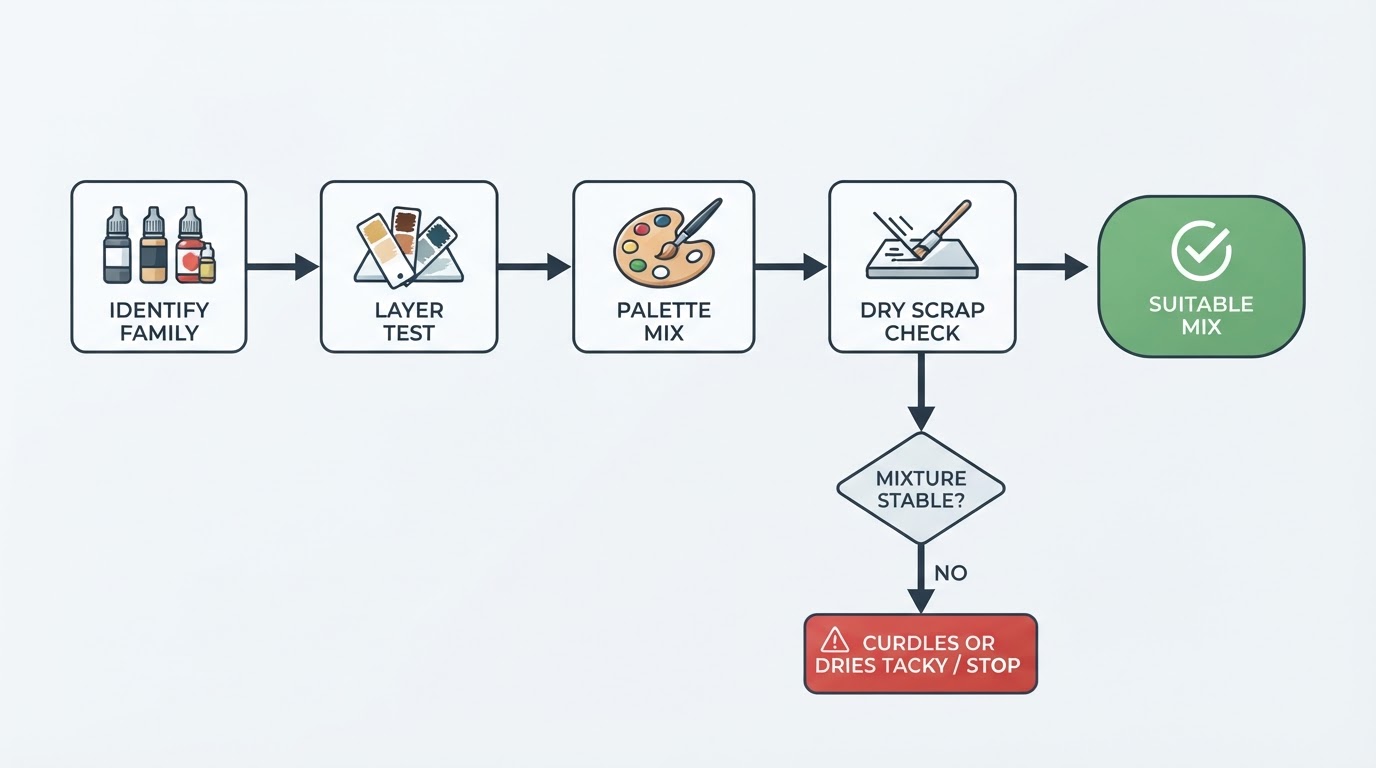
A palette test costs two drops of paint and a few minutes. Keep it small, keep it away from the bottle, and treat it as a check on this pair of products rather than a permanent verdict on either brand. Everything here stays at room conditions with ordinary amounts of paint; there is no need to heat, concentrate, or otherwise stress the mixture.
- Confirm both products are water-based hobby acrylics and read the thinner and cleanup instructions on each label.
- Prepare a scrap piece with the same primer and basecoat you use on your models, so the test surface resembles the real one.
- Put one drop of each paint on a clean palette, a short distance apart. Note the consistency and sheen of each before they touch.
- Pull a small amount from each drop with a clean brush and mix them in a separate spot. Use a fresh area of the palette so you can compare the blend against the two originals.
- Watch the wet mix as you combine the drops. Note clumping, stringy separation, beading, or a watery layer, and check whether the two paints blend into an even color. A change is a reason to pause and look closer, not by itself a confirmed incompatibility.
- Apply a thin coat to the scrap and let it dry under the conditions the label describes, then apply a second thin coat over the first. The second pass is one place where lifting or re-wetting can show up.
- Inspect the dried sample when it is ready. Compare its sheen and color with swatches of each original paint, and look for flaking, cracks, or soft patches. If the label allows handling and you need to check adhesion, use a clean, suitable tool and light pressure. Whatever you see applies to this short window only.
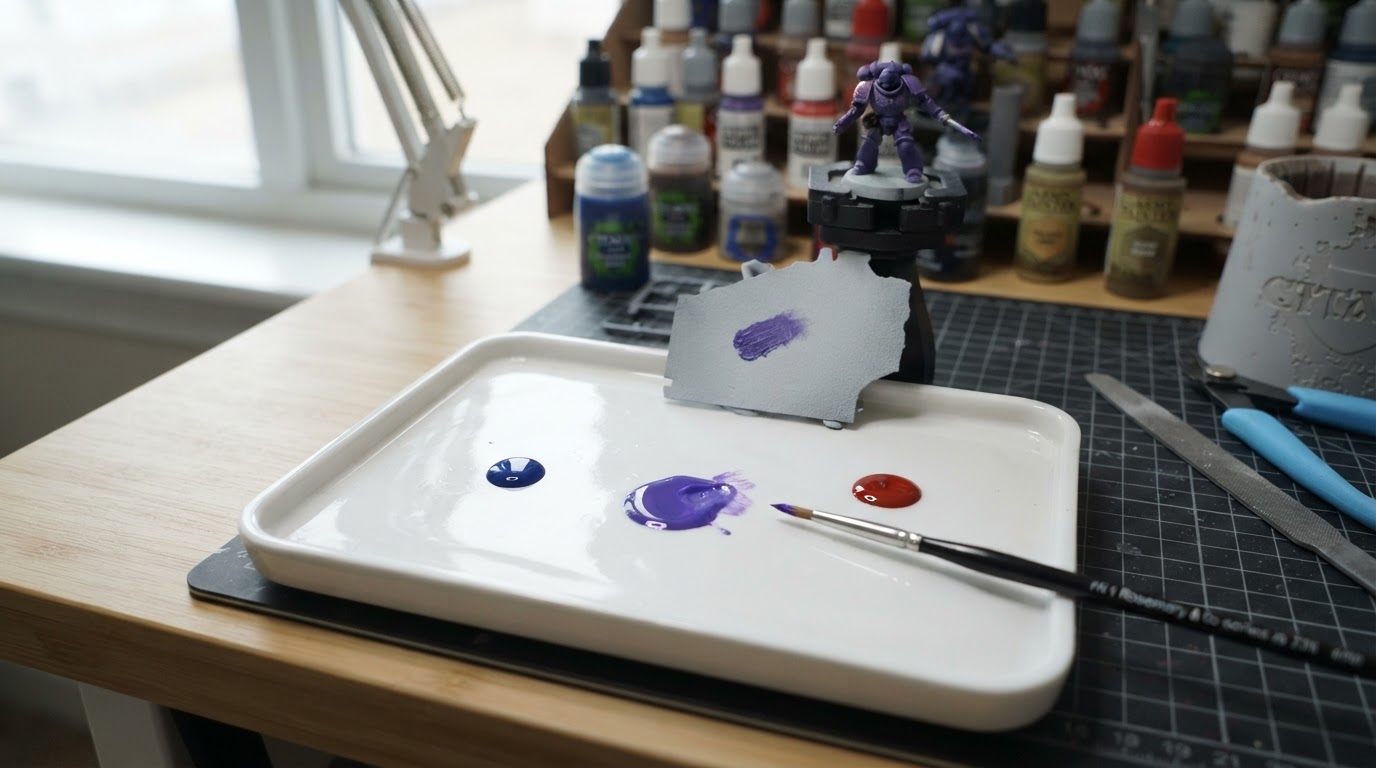
Wet signs worth pausing on
Many wet oddities have ordinary explanations. Beading can come from a contaminated or greasy surface, from too much paint on the brush, or from the way the paint was loaded. A muddy color can come from the pigments you chose rather than from the binder. A watery layer can separate because of pigment density, storage, or how well the bottle was shaken. None of those on its own proves that the two products are chemically incompatible.
Unexpected persistent clumping or stringiness that will not smooth out with normal mixing is a reason to stop that sample and check both labels. So is a dried film that stays tacky beyond what the product's own instructions and drying conditions lead you to expect. Treat that as a signal to stop this attempt, not as a confirmed chemistry diagnosis. Start a fresh test on a new scrap if you want to try a different ratio or pair.
What to check after it dries
Record what you see on the dried scrap: sheen, color, coverage, and whether the film feels soft or tacky when the label's handling conditions allow a light touch. Whether a film is still tacky depends on the product's stated dry and cure conditions, the temperature and humidity where it dried, and how thick the coat was. Check the label before you decide the mix failed, and treat tackiness as a reason to wait or stop rather than as an exact cure-time verdict.
Also look for a gloss level that clashes with the surrounding paint, pigment that comes away under light handling, and edges that lift when you apply the second thin coat. If you plan to varnish later, note that a short scrap check does not tell you how the mixed film will react to a varnish or a wash.
A decision table for common situations
Situation | Reasonable first move | Stop or rethink when |
|---|---|---|
Two water-based hobby acrylics from different brands | Read both labels, then run a two-drop palette mix and a scrap check | The blend keeps clumping after normal mixing, or the dried film stays tacky beyond the label's conditions |
One product thins with water and the other needs a solvent thinner | Treat them as different paint families and keep the solvent product separate | You were about to combine them wet or use one brand's thinner on the other |
Two water-based colors with very different finishes | Test the pair on scrap and compare the dried sheen with swatches of each original | The dried sheen is one you cannot accept next to the rest of the model |
Brand A as a basecoat, brand B as a highlight | Test the layering order on a primed scrap and follow the first product's recoating conditions | The second layer lifts the first or beads on it |
A wash or contrast-style product over another brand's basecoat | Check the maker's guidance for that product and test on scrap | The wash reactivates the basecoat or dries patchy |
Failure and stop signs
Pause and check the labels when you see persistent clumping or stringiness that will not mix smooth, a film that stays tacky beyond the conditions the product describes, flaking or cracking on the dried scrap, or a second coat that lifts the first. Those observations mean stop that sample; they do not explain why it happened, and they are not a chemical diagnosis.
Beading, a muddy color, or a watery separation on its own is weaker evidence. Surface contamination, pigment choice, storage, and how the paint was loaded can all produce those effects, so note them and test again before you conclude anything about the brands.
Keep the handling simple and low-risk: two drops on a palette and a scrap piece at room conditions, with no heating, concentrating, or other stress on the mix. A failed two-drop test is cheap. A failed coat on a finished miniature is not.
Do not pour a failed or experimental mix back into either bottle, and do not add a second brand to a bottle to "improve" it. Keep the bottle as the manufacturer made it, and use the palette for every combination. If a solvent-based product is involved elsewhere in your workflow, follow its ventilation and disposal instructions and keep it away from water-based tools, brushes, and palettes.
What a scrap check cannot tell you
A short test answers one narrow question: does this pair, at this ratio, on this surface, behave acceptably during the first days? It cannot establish long-term durability, lightfastness, or yellowing resistance. It cannot tell you how the film will hold up to handling, foam trays, or repeated varnishing. It also cannot prove that a second bottle of the same product will behave the same way, because batches and product revisions can vary. The evidence is limited to initial film behavior over a short period, so keep the scrap labeled with the two product names and the date if you want a reference for later, and repeat the check when you open a new bottle of either paint.
Keep the bottle out of the experiment
Every test in this guide happens on a palette or a scrap piece, never in the bottle. Do not top up one brand with another, do not thin a whole bottle with a different brand's medium, and do not return unused mixed paint to its original container. If a pair passes the scrap check and you want to use it across a unit, mix a batch large enough for the job on a palette or in a clean mixing cup, and write down the ratio you used so the next batch matches. Keeping water-based tools and solvent-based tools separate is the simplest way to avoid a chemistry mistake later.
Quick answers to common mixing questions
Can I mix two water-based acrylics from different brands?
Usually yes, with a label check and a small palette test first. Do not assume the blend will inherit a predictable middle ground: sheen, coverage, and handling can shift in ways neither bottle predicts, even when the mixture looks fine.
Can I mix an acrylic with an enamel or a lacquer?
Do not treat that as a routine mix. Those products are built around different solvent systems and different cleanup rules. Keep them in separate workflows and use the thinner specified by each manufacturer.
Can I add another brand's paint to a bottle to stretch it?
No. Mix on a palette or in a separate cup. Adding a second product to the bottle changes the whole container and removes any chance of isolating a bad combination.
Does a successful palette mix prove the paint is safe on a finished model?
No. A wet palette mix only shows how the two paints blend while they are still fluid. Observing a dried scrap that matches your surface adds evidence about how that particular film behaved over a short period. Neither result proves long-term durability, adhesion, lightfastness, or varnish compatibility. Keep the bottle untouched and repeat the check when the pair matters.