There is no single answer to "how long does miniature paint take to dry": a thin acrylic layer can be touch-dry in minutes, and the next safe step depends on your product's own recoat guidance, not a timer. Acrylics dry as water evaporates, and miniature paints are formulated to dry quickly (The Army Painter on paint drying too fast). Its basecoating walkthrough says to let a basecoat dry completely before the next stage, which can take a few minutes to about an hour depending on thickness and humidity — a rule of thumb, not a guarantee.
Choose the next step, not just a timer
A timer cannot tell you whether a layer is ready, because "dry" means something different for each next step. Decide the step first, then check it on a matching scrap piece — a spare part or hidden area painted in the same session — following your product's instructions.
Your next step | What the layer must survive | Proceed when the test piece shows |
|---|---|---|
Another thin coat | A light, thinned pass that must not lift the layer below | A clean, dry brush strokes the piece without moving colour |
A wash, ink or glaze | Extra liquid over a layer that must stay put | The wash runs cleanly without disturbing the layer below |
Varnish or protective coat | The maker's recoat window, plus added liquid | It applies with no lifting or change of finish |
Handling or storage | Normal contact after the maker's window | It handles without paint transferring to a cloth |
Primer to basecoat | A dry primer coat per its label | The primer looks even, with no soft patches |
Every row assumes you follow your products' instructions, not a generic chart.
What "dry" can mean
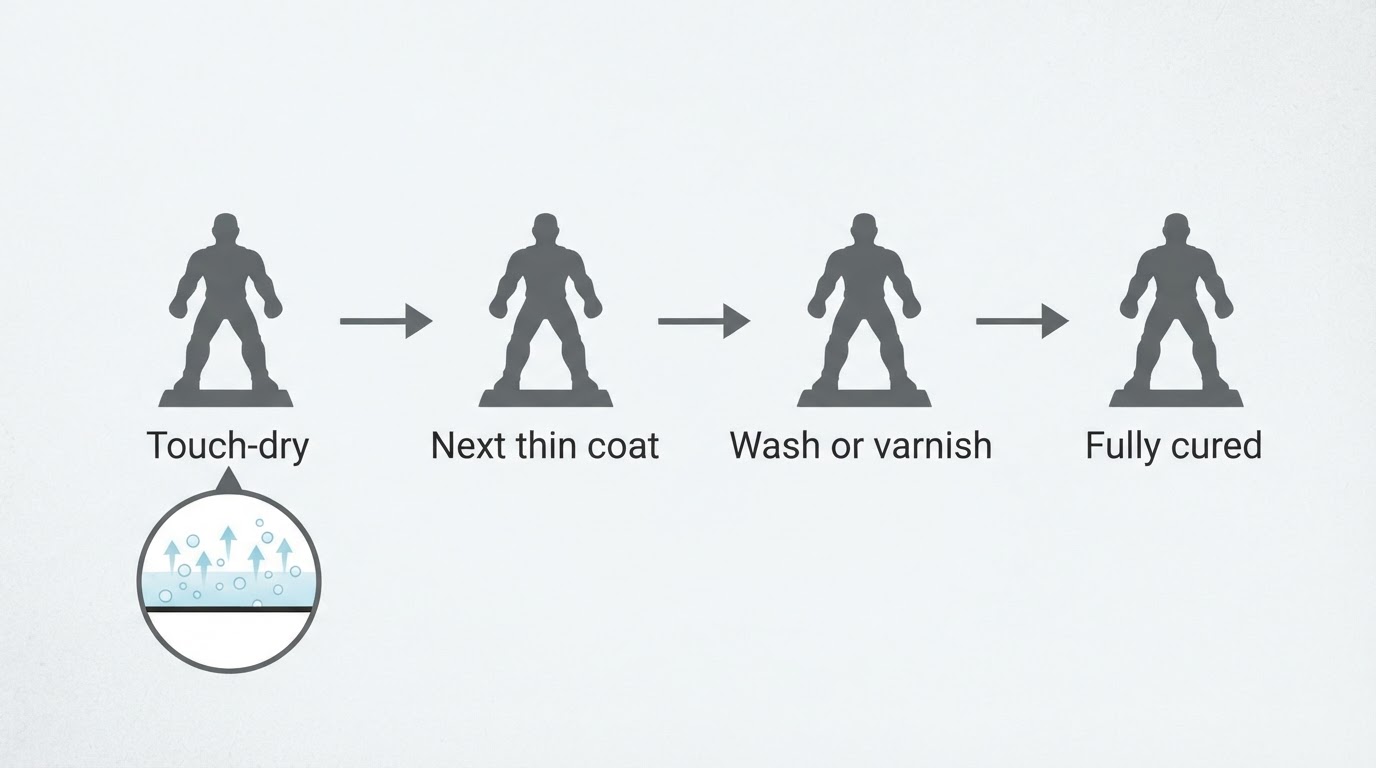
- Touch-dry. The surface stops transferring wet paint, but that says little about the film underneath.
- Ready for another thin coat. The layer has set enough that a light pass will not drag or lift it.
- Ready for a wash or varnish. The next product adds liquid on top, so "ready" is whatever its maker states.
- Fully dry or fully cured. Makers use these words in their own guidance, with product-specific meanings. A surface that feels dry cannot confirm this stage, so follow the exact wording on the pot, flyer or label rather than assuming hours or days.
Test on a matching scrap piece
Before committing a whole figure to the next stage, work on something unseen: a spare part, the base underside, or a second figure painted alongside.
- Paint it with the same products, in the same session, following their drying and recoat guidance.
- After the maker's stated wait, test the scrap piece, not the model. A light pass with a clean, dry brush, or the next product applied to the piece, shows whether the earlier layer moves or lifts.
- If it fails, wait longer before retesting, and return to the maker's guidance.
- Keep it bounded: a clean check describes how these products behaved on that piece. It is not proof of full cure, or of compatibility with a different product or surface.
Hold the miniature by the base or a painting handle, so a fresh layer is never touched.
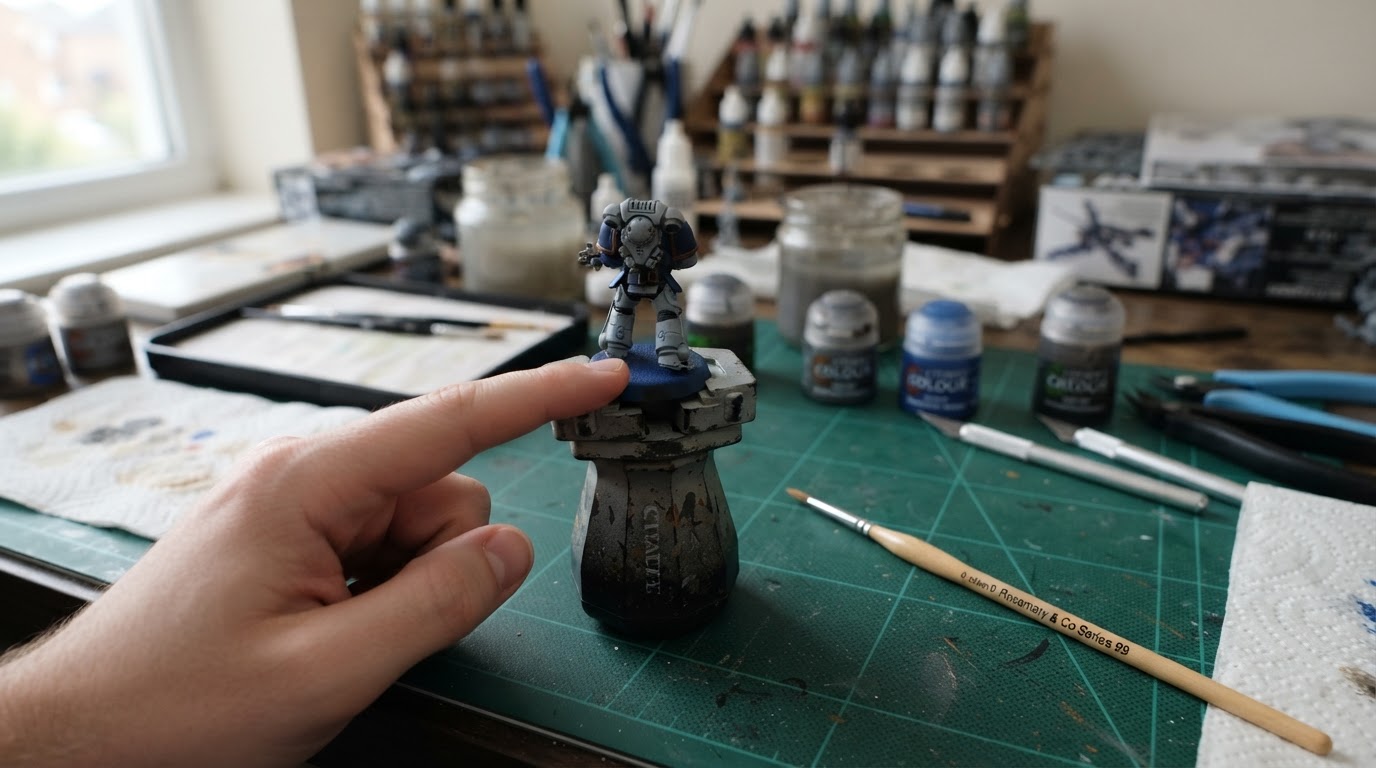
What actually changes the wait
- Coat thickness. Drying time follows how thickly the paint goes on: a thin coat is ready sooner, a flooded pass takes longer. Pooling depends on how you apply the paint, not on the range's name — one-coat products can go on thin, and any acrylic can be flooded. The basecoating guidance also applies one or two thinned layers to preserve detail.
- Heat, low humidity and airflow. The Army Painter guidance notes that heat, low humidity, sunlight, fans and air conditioning speed up evaporation, shortening working time on the palette and skinning over a layer early. It suggests avoiding a fan, heater or strong sunlight when you need more time.
- Palette and brush habits. Paint drying on the palette or in the brush is a different problem from paint drying on the model. A wet palette slows evaporation and keeps paint workable for longer; mix out only the next few minutes and rinse the brush regularly.
If you need more working time rather than a faster dry, the same guidance points to an acrylic retarder medium. If paint has set in the bristles, use the miniature paint brush cleaning guide instead of extending drying time, and the miniature painting checklist generator to keep a session's steps in order.
Limits worth knowing
- Touch-dry is not fully dry or fully cured.
- A scrap-piece check covers that piece and those products only.
- Follow the label for ventilation and recoat windows, especially with enamels and lacquers.
- The sources cited here cover acrylic working time, not a universal timetable; any range is a starting point.
Paint-session record
Copy this record into your notes and fill it in as you go. It tracks what you observed — not manufacturer advice or measured evidence.
Record field | Your notes |
|---|---|
Product and range | |
Next product or step | |
Coat thickness as applied (thin, medium, thick or pooled) | |
Room conditions, if known (temperature, humidity, airflow) | |
Maker's stated wait or recoat window | |
Scrap-piece outcome once that window passed |
FAQ
How long should I wait between thin acrylic coats?
The Army Painter basecoating guidance puts a completed basecoat anywhere from a few minutes to about an hour, tied to paint thickness and room humidity: a thin coat at the quick end, a flooded coat at the slow end. Treat it as a rule of thumb, confirm on a scrap piece, and follow your product's recoat window.
Do different miniature paint ranges dry at different speeds?
Water-based acrylics share the same mechanism — water leaves the film — and thickness, humidity and airflow decide how long that takes. Read the label for the paint in front of you rather than applying one brand's number to another.
Can I speed up drying with heat or moving air?
The guidance cited here does not recommend heating paint to dry it. It explains that heat, fans, sunlight and air conditioning speed up evaporation and shorten working time, and it suggests the opposite habits when you need more time: paint away from a fan, heater or strong sunlight, and use a retarder medium for longer blending. Follow a label's drying instructions where they exist.