The short answer for painted miniatures
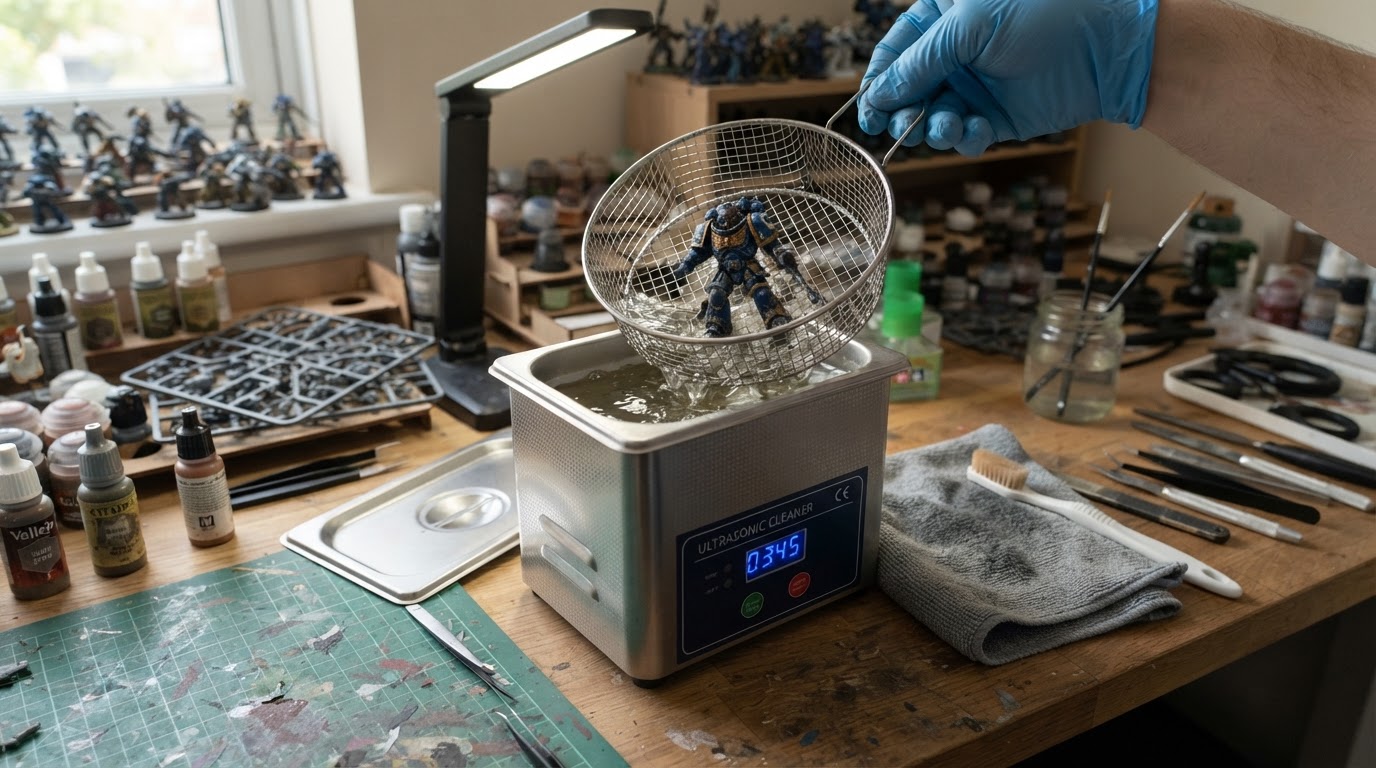
A benchtop ultrasonic cleaner uses high-frequency vibration in a permitted cleaning liquid to create cavitation. That mechanical action can reach recesses, but it also acts on fragile details, coatings and glued joints. The Elmasonic Easy manufacturer page links its operating instructions; those instructions, not a generic hobby recipe, govern the liquid and operation for that machine.
That action is mechanical, not a chemical promise to dissolve a cured acrylic film. It may help remove loose paint or debris, but a sound paint layer may remain. The result also depends on the coating, miniature material, cleaner model and liquid.
Agitation and chemistry are two different jobs
Agitation belongs to the machine: cavitation, temperature and cycle time are governed by its manual. A separate paint remover has its own material compatibility and safety instructions; do not assume that a remover safe in a hand-soak is safe in an ultrasonic tank.
For example, Elma's Elmasonic safety instructions say not to fill the cleaning tank with flammable liquids and to use only agents approved for the unit. Ordinary machines are not the same as specialized explosion-protected solvent systems. Do not put isopropyl alcohol, acetone or other flammable stripping solvents in an ordinary tank, and do not improvise a beaker-in-water workaround.
Heating and mixing introduce more uncertainty: do not heat the bath to speed up paint stripping or blend cleaners unless both the machine and chemical manufacturers explicitly permit that use.
What each miniature material can take
Compatibility decides whether this is wise at all. Miniatures sold as "plastic" or "resin" may use different formulations and adhesives. A safe setting for a metal part or a maker-approved cleaning resin does not establish a safe setting for an assembled, painted miniature.
Material | What governs it | Reasonable use | Stop signs |
|---|---|---|---|
Injection-molded plastic (including polystyrene) | Exact plastic, paint, glue and cleaner-liquid compatibility | Use only if the miniature maker and machine manual permit it; test a spare sprue first | Frosting, crazing, softening, warp or loosening joints |
Cast resin | Resin maker's cleaning advice and fragile thin details | Do not assume a bath is suitable; test a spare piece only if approved | Chipped edges, tacky spots or softened detail |
UV-printed resin | Print-resin maker's wash and post-cure instructions | Follow the resin maker's process; a cured display model is not the same as an uncured print | Sticky surfaces, warping or lost detail |
Metal and plated parts | Alloy, plating, paint and cleaning-agent compatibility | Consider a test part with a machine-approved water-based liquid | Tarnish, plating lift or damage to attached nonmetal parts |
Metal is not automatically safe: alloys, plating, glued parts and coatings vary. Follow the cleaner's approved-agent list and test a representative spare part.
Why the manual sets the liquid, temperature and time
- Liquid. Use only the non-flammable, water-based cleaning agent approved for that machine and the item. Water alone does not make an incompatible miniature safe to ultrasonically clean.
- Temperature. A machine's maximum temperature is not a safe limit for a miniature. Do not heat an unidentified or heat-sensitive part to accelerate stripping.
- Time. No universal cycle length applies across cleaners and miniature materials. If both makers permit a trial, use their shortest applicable setting on a spare part and inspect it before any further exposure.
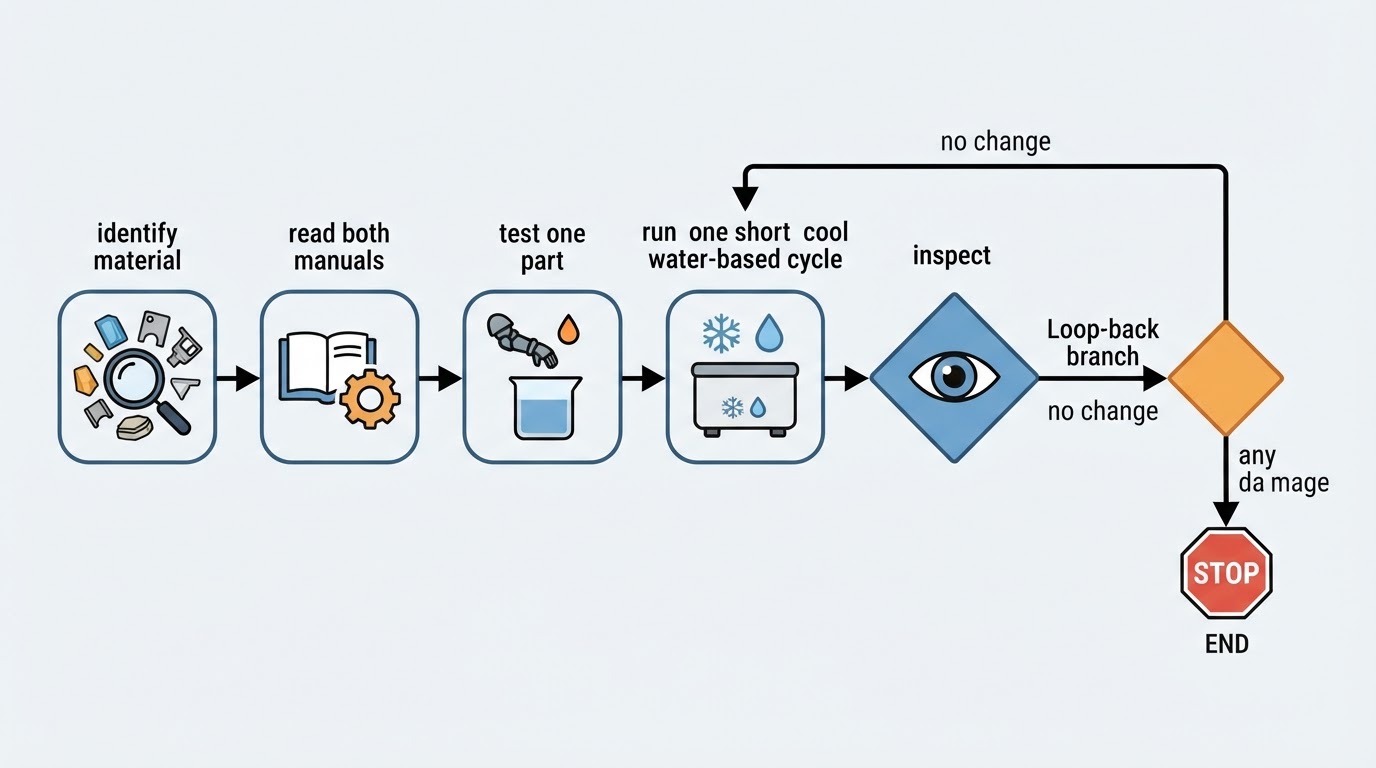
A cautious first attempt, step by step
- Identify the material from the sprue, box, or maker's page; treat unknown plastic as the most sensitive case.
- Read both manuals: the cleaner's allowed liquid, temperature and cycle guidance, plus the miniature maker's material guidance.
- Test one spare part or painted sprue before a finished model; skip the bath entirely if compatibility is unknown.
- Fill the unit only as its manual directs, with an approved non-flammable liquid and the specified basket or holder. Do not put a miniature on the tank bottom unless the maker explicitly allows it.
- Use the shortest applicable maker-approved cycle without added heat; do not invent a universal duration.
- Inspect under strong light for frosting, crazing, softening, warping, lost detail or unexpected paint lift.
- Repeat only if both manufacturers permit it and inspection shows no damage. Stop immediately at the first sign of change.
- Rinse and dry only as the miniature and cleaner manufacturers direct for the chosen agent.
Safer alternatives, and when to stop
For most painted plastic miniatures, hand-stripping with a paint remover made for the job — in a separate container, with the ventilation and gloves its label requires — beats an ultrasonic bath. Priming and repainting over a sound old coat is often the practical answer if you want less chemistry.
Stop before you start if you cannot identify the material, if the maker rules out a bath, or if the model is thin-walled, aged or brittle. Stop mid-process if the surface frosts, thin parts flex, fine detail softens, or glued and cement-held parts move. The heat and vibration that clean a part can also loosen assembled joints.
Limitations
- The bath supplies mechanical cleaning, not a guarantee that cured acrylic will strip; do not keep extending cycles simply because the coating remains.
- Cavitation attacks every exposed surface, so the detail you want to keep gets the same energy as the paint you want gone.
- Hobby machines vary widely in frequency, power and temperature control.
- Resins differ between makers and batches, so maker guidance plus a test part is the only reliable route. When the cleaner manual and the resin guidance disagree, the stricter limit wins.
FAQs
Can I put isopropyl alcohol or acetone in the ultrasonic tank to strip miniatures?
No, not in an ordinary ultrasonic cleaner. Elma's published safety instructions prohibit flammable liquids in its tank; the risks and permitted agents for your model are in its manual. Specialized solvent-rated equipment is a different category. If a solvent is compatible with the miniature, use it only by its own label and safety data sheet, away from the ultrasonic equipment.
Is there a soak time that works for every miniature?
No. It depends on the miniature, coating, liquid and machine. If both makers allow a trial, test a spare part at the shortest applicable approved setting and stop if any surface changes.
Will an ultrasonic cleaner strip paint from a plastic miniature?
It may lift paint that is already loose, but it is not a universal paint stripper. Plastic formulations and adhesives vary, so do not put a finished miniature in a bath without material and machine compatibility guidance. See our separate resin-miniature stripping guide for a different method; its solvent instructions do not transfer to ultrasonic equipment.