The short answer
Painting red hair miniatures is a placement problem before it is a paint problem. Keep the midtone darker than your instinct, let orange act only as a final accent, and place the four tones in order: shadow in the recesses, midtone across the mass, highlight on raised strand clusters, palest tone at the tips. If you are learning how to paint red hair without the sunburn look, this order matters more than the red you start from.
Why red hair goes flat orange
Some red miniature paints need several build-up stages to look rich, as the cited painter's notes explain. A single bright coat also reads flat because there is no darker depth underneath for light to fall across.
The second reason is the highlight. The 'Eavy Metal masterclass notes on Tale of Painters are blunt about hair: over-highlighting changes the color, turning red hair orange or pink, and the fix is a thin red glaze that reasserts the red (masterclass notes).
Perception matters too. Hair reads as horizontal bands of light and shadow shaped by the bulk of the hair (waves, curls, the curve of the skull) rather than as vertical strands. That is why shadows belong under curls and highlights on top of them (How to Paint Hair).
The four-placement recipe
Treat the hair as four placements, and keep them in this order.
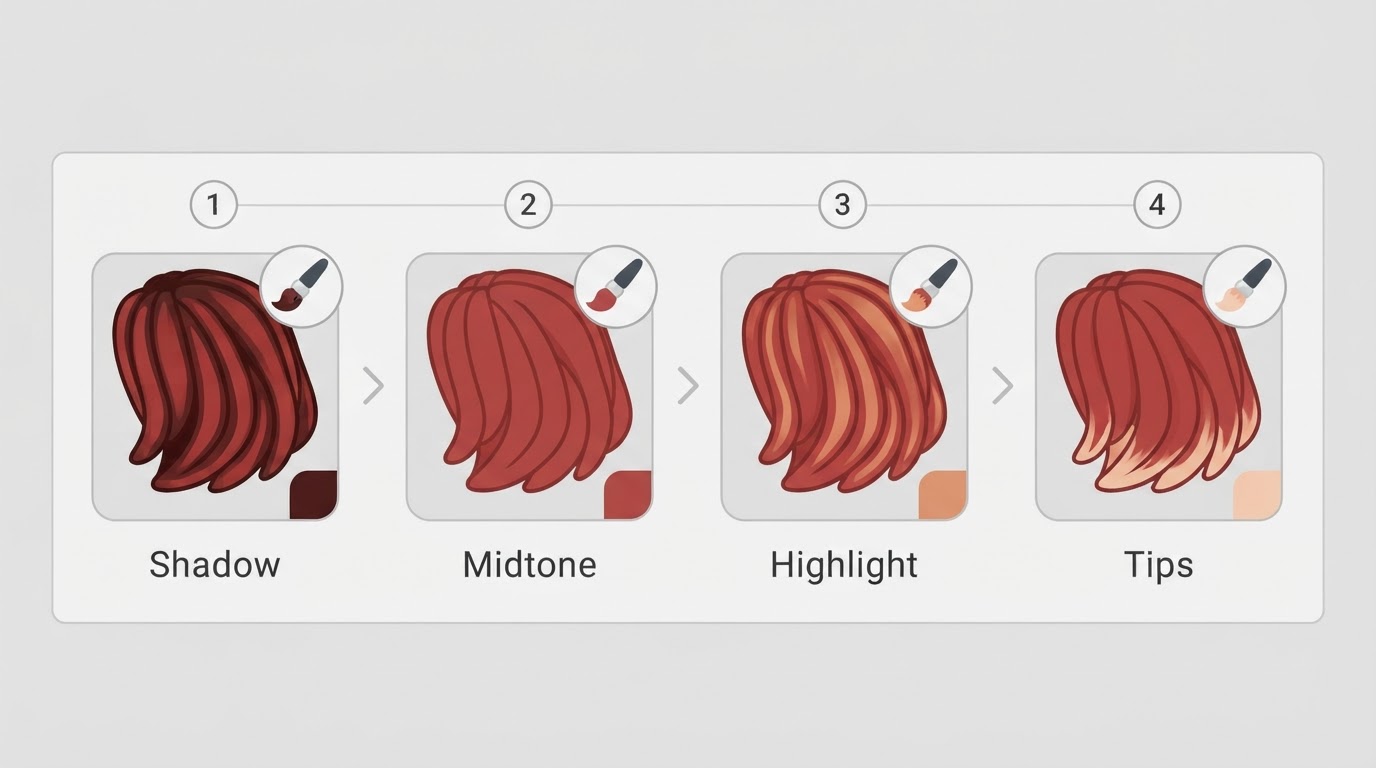
- Shadow first, in dark red-brown. Push a dark brownish red into the roots, under the fringe, behind the ears and into every crease. Leave it visible: it is definition, not a mistake.
- Midtone in strand groups. Paint a muted red over the raised groups of strands and stop before you fill the recesses. Keep this tone duller and darker than a pure red; a light, saturated midtone is what reads as orange.
- Selective highlight. Add a warmer red only to raised strand clusters facing your light. Follow the bulk shape rather than outlining every strand.
- Tips and texture. Put the lightest warm tone at the tips and most prominent edges, then add a few thin strokes along the sculpted strands, or dampbrush across the texture so raised areas catch paint and the depressions stay shaded.
Zone | Tone | Placement | Common mistake |
|---|---|---|---|
Recesses and roots | Deep red-brown shadow | Under curls, fringe and behind the ears | Using black, which reads as a drawn hairline |
Bulk of the hair | Muted red midtone | Raised strand groups | Mixing it too light, which floods the head orange |
Raised strand clusters | Warmer red highlight | Surfaces facing the light | Highlighting every strand equally |
Tips and edges | Palest warm tone | Strand tips, most prominent edges | Spreading it over the whole head |
Choose the red family first
Ginger, auburn and saturated fantasy red are three different placements, not one recipe with the dial up.
Family | Shadow anchor | Midtone | Highlight | Watch for |
|---|---|---|---|---|
Ginger | Warm brown | Light orange-red | Pale gold-orange at the tips | Reading as flat orange, because the shadow is too red |
Auburn | Dark red-brown | Deep rust red | Muted red-copper | Losing the red and reading as plain brown |
Saturated fantasy red | Deep maroon or purple-red | High-chroma crimson | Hot red | Highlights sliding into neon pink |
Whichever family you pick, keep the same order: shadow, midtone, selective highlight, tips. Move the hue, not the structure.
Diagnostic matrix: hair that already reads flat orange
Symptom | Likely cause | Fix |
|---|---|---|
Orange across the whole head | Midtone too light and highlight too broad | Darken the midtone, glaze with thin red, then re-place the highlight on a smaller area |
Pink cast in the highlights | Highlight mixes cooled with white or pale flesh | Rebuild the highlight with warm yellow-brown or orange mixes, then glaze red over the pink |
Brown, with no red left | Shadow dominates and the highlight is too muted | Take the midtone back toward red and add a rust or orange highlight |
A solid helmet of color | No strand definition, one flat pass | Leave the dark base in the recesses, rebuild midtones in strand groups, then add a few light tips |
Roots look black | Black used along the hairline | Repaint with dark red-brown; black hair edges look drawn rather than painted |
What this recipe cannot do
- It assumes some sculpted strand depth. On soft or flat-cast hair you must paint the strand direction yourself, and it reads as a suggestion rather than real texture.
- Placement depends on your light direction: change the assumed light and keep the order of tones, not their literal position.
- It is brand-neutral and promises no color matching: the placement logic holds across red ranges, but values differ from figure to figure.
- Below roughly 15 mm, the fourth placement usually disappears. Three tones are enough at that size.
Practice on a spare figure first
Paint one complete pass on a spare model before you touch a character piece. If you use a translucent contrast-style paint for speed, treat it as an initial layer and still place the shadow and selective highlight yourself. For the adjacent task of balancing those hair values against the skin, see our miniature-face painting guide.
FAQ
Should I shade red hair with black?
No. Black along the hairline looks drawn rather than painted, and the 'Eavy Metal notes warn against it. Reach for a dark red-brown instead; you can go very dark without leaving the red family.
Do I need orange paint to paint red hair?
No. Orange is a late accent for raised highlights, not a base. The masterclass guidance is to remember that you are painting red, not orange or pink, and to keep a thin red glaze ready for pulling the color back if the highlights drift.
How do I paint ginger hair on Warhammer or 40k figures without it turning orange?
Keep three things separated: a warm brown shadow, a muted orange-red midtone a step darker than the bright orange you pictured, and a pale gold-orange highlight only on the tips. The same logic works for a dwarf beard or a 40k redhead squad leader: the risk is almost always the midtone, not the highlight.